
Sets is an important topic in Mathematics that covers the basic concepts of sets and their representation, types of sets, set operations, and the use of Venn diagrams to understand relationships among different sets.
For Officer Cadet Entrance Exam preparation, questions on sets and Venn diagrams help develop mathematical reasoning and the ability to identify relationships, intersections, unions, and differences among groups. This resource covers essential concepts of sets, Venn diagram techniques, useful tricks, and practice questions. Explore the complete Officer Cadet Exam resources and Maths for Officer Cadet for additional practice and study materials.
What is a Set?
A set is a collection of well-defined objects with common and distinct features. The objects in a set are called elements or members of the set. Sets are usually denoted by capital letters and represented by listing elements within curly brackets { } .
Example: A = {1, 2, 3, 4, 5}
Sets for Officer Cadet: Syllabus
This Mathematics for Officer Cadet Entrance Exam Preparation resource covers the following main topics:
1. Concepts of Sets
2. Applications of Venn Diagrams
1. Concepts of Sets
A set is a well-defined collection of distinct objects. This means that it is possible to clearly determine whether a particular object belongs to the collection or not.
The objects in a set are called elements or members of the set.
Example:
The set of vowels in the English alphabet can be written as:
A={a,e,i,o,u}
Here, a, e, i, o, and u are the elements of set A.
Set Notation Methods
There are two primary ways to represent sets:
👉 Roster or Listing Method: All elements are listed explicitly.
Example: A = {2, 4, 6, 8, 10}
👉 Rule or Set-Builder Method: A rule describes the elements.
Example: A = {x : x is an even number less than 12}
Types of Sets
Understanding the different types of sets is fundamental for solving Officer Cadet exam questions.
| Type of Set | Definition | Example |
|---|---|---|
| Singleton Set | Contains only one element | A = {3} |
| Empty/Null Set | Contains no elements, denoted by ∅ or { } | A = {x : x is a number, 1 < x < 2} |
| Finite Set | Contains a finite number of elements | A = {2, 4, 6, 8} |
| Infinite Set | Contains an infinite number of elements | N = {1, 2, 3, 4, …} |
| Universal Set | Superset of all sets under consideration | U = {1, 2, 3, …} |
| Subset | All elements of A are in B | If A = {1,2} and B = {1,2,3}, then A ⊂ B |
| Proper Subset | A ⊆ B but A ≠ B | Same as above |
| Equal Sets | Both sets contain exactly the same elements | P = {3,6,8}, Q = {6,3,8} |
| Power Set | Collection of all subsets of a set | If A = {1,2}, P(A) has 2² = 4 elements |
Set Operations
Set operations are the building blocks for solving complex problems. The three fundamental operations are:
Union (∪)
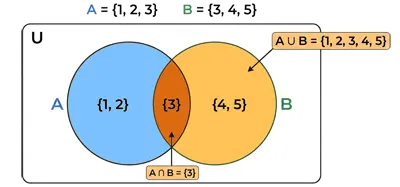
The union of two sets A and B is the set containing all elements that are in A or in B .
Formula: A ∪ B = {x : x ∈ A or x ∈ B}
Example:
A = {1, 2, 3}
B = {3, 4, 5}
A ∪ B = {1, 2, 3, 4, 5}
Notice that 3 appears in both sets, but it is listed only once in the union.
Intersection (∩)
The intersection of two sets A and B contains only elements that are in both A and B .
Formula: A ∩ B = {x : x ∈ A and x ∈ B}
Example:
A = {1, 2, 3}
B = {3, 4, 5}
A ∩ B = {3}
Notice that only 3 appears in both sets, so 3 is the only element in the intersection.
Difference (−)
The difference A − B contains elements that are in A but not in B.
Formula: A − B = {x : x ∈ A and x ∉ B}
Example:
A = {1, 2, 3, 4}
B = {3, 4, 5}
A − B = {1, 2}
Notice that 3 and 4 are removed because they appear in B, leaving only the elements that are in A but not in B.
Complement (A′ or Aᶜ)
The complement of A contains all elements in the universal set that are not in A .
Formula: A′ = {x : x ∈ U and x ∉ A}
Example:
U = {1, 2, 3, 4, 5}
A = {2, 4}
A′ = {1, 3, 5}
Notice that 2 and 4 are removed because they are in A, leaving only the elements of the universal set that are not in A.
2. Applications of Venn Diagrams
A Venn diagram is a visual tool that uses overlapping circles or shapes to show the logical relationships, similarities, and differences between two or more sets. They help visualize unions, intersections, and differences among sets.
Key Formulas for Two Sets
For two sets A and B, the fundamental counting formula is:
n(A ∪ B) = n(A) + n(B) − n(A ∩ B)
Where:
👉 n(A ∪ B) = number of elements in A or B (or both)
👉 n(A) = number of elements in A
👉 n(B) = number of elements in B
👉 n(A ∩ B) = number of elements in both A and B
Example:
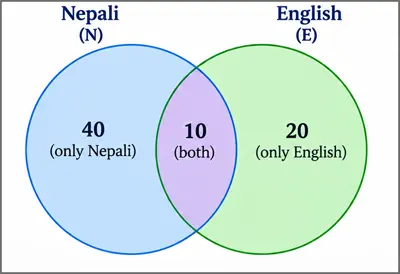
In a group of students, 50 students either speak Nepali or English, 10 prefer speaking both Nepali and English, and 20 prefer only English. How many students prefer speaking Nepali? Explain both by formula and by Venn diagram.
Let:
N = students who prefer speaking Nepali
E = students who prefer speaking English
N ∪ E = 50
N ∩ E = 10
Only English = 20
First, find the total number who prefer English:
E = 20 + 10 = 30
Using the union formula:
n(N ∪ E) = n(N) + n(E) − n(N ∩ E)
Substitute the values:
50 = N + 30 − 10
50 = N + 20
N = 50 − 20
N = 30
Therefore, 30 students prefer speaking Nepali.
Key Formula for Three Sets
For three sets A, B, and C:
n(A ∪ B ∪ C) = n(A) + n(B) + n(C) − n(A ∩ B) − n(B ∩ C) − n(C ∩ A) + n(A ∩ B ∩ C)
Example:
In a class, students like to play these sports — Football, Basketball, and Volleyball. 5 students play all 3 sports, 20 play Football, 30 play Volleyball, and 40 play Basketball. 10 play both Basketball and Volleyball, 12 play both Football and Basketball, and 9 play both Football and Volleyball. How many students are present in the class?
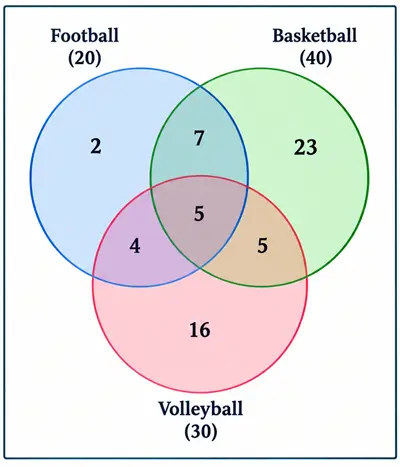
n(F ∪ B ∪ V) = n(F) + n(B) + n(V)
− n(F ∩ B) − n(B ∩ V) − n(F ∩ V)
+ n(F ∩ B ∩ V)
= 20 + 40 + 30 − 12 − 10 − 9 + 5
= 90 − 31 + 5
= 64
So, 64 students play at least one sport.
Effective Tricks to solve Sets Questions
These tricks will help you solve sets and Venn diagram questions quickly and accurately.
Trick 1: Start with the Center (Three-Set Problems)
In three-set Venn diagram problems, always start with the innermost region — the intersection of all three sets, n(A ∩ B ∩ C). This region is the most constrained because it’s part of all overlapping areas. Solving it first prevents contradictions in outer regions.
Trick 2: Use “Only” vs. “At Least” Carefully
👉 “Only A” means elements in A but not in B or C
👉 “At least A” includes elements in A, regardless of whether they’re in other sets
👉 Misinterpreting these terms leads to overcounting or undercounting
Trick 3: Convert Percentages to Absolute Values
For percentage-based questions, assume a total of 100 and convert percentages to whole numbers. This reduces calculation errors.
Example: If 60% passed Mathematics and 50% passed Science, assume 100 students. Then 60 passed Mathematics and 50 passed Science.
Trick 4: Maximize and Minimize Overlaps Strategically
For maximum overlap: The maximum possible intersection equals the smaller of the two sets. If 70% like A and 60% like B, maximum overlap = 60%.
For minimum overlap: Use the formula: Minimum Overlap = n(A) + n(B) − Total .
Trick 5: Use the “All or None” Rule
👉 If “All A are B”, then A ∩ B = A (the A circle lies completely inside B)
👉 If “No A are B”, then A ∩ B = 0 (the circles are disjoint)
Trick 6: Draw and Label Every Region
When solving complex problems, draw the Venn diagram and label every region with either values or variables. This visual approach reduces errors and makes the solution path clear.
Important Tips to solve Sets Questions
👉 Practice regularly — Sets and Venn diagrams require consistent practice to master.
👉 Draw diagrams — Never solve complex set problems without drawing a Venn diagram.
👉 Double-check “only” questions — These are the most common trap in exams.
👉 Memorize the formulas — Both two-set and three-set formulas should be at your fingertips.
👉 Time yourself — Practice under exam conditions to improve speed and accuracy.
Practice Questions
Conclusion
Sets and Venn diagrams are important parts of the mathematics syllabus for Officer Cadet Entrance Exam preparation. Most set questions can be solved efficiently once you understand the meaning of union, intersection, difference, complement, and the relationship between different groups.
Focus on the key formulas, learn to translate words such as “and,” “or,” “only,” “both,” “at least one,” and “neither” into set operations, and practise drawing Venn diagrams for numerical problems. With regular practice, set questions can become a quick-scoring area in the Mathematics section.
This resource is part of the Officer Cadet Entrance Exam Preparation series, focusing on Maths for Officer Cadet Entrance Exam. For structured lessons, comprehensive practice question banks, and mock tests, explore the Sets for Officer Cadet section of the Maths for Officer Cadet Entrance Exam course on the Pratima Academy LMS.