
Analytical Reasoning Test is an important part of IQ and Logical Reasoning that tests your ability to analyse figures, count geometric shapes, and solve visual problems using logical reasoning.
For Officer Cadet Entrance Exam preparation, these questions help develop spatial visualization, observation, systematic counting, and analytical thinking skills. Explore the complete Officer Cadet Exam resources and IQ for Officer Cadet preparation for additional practice and study materials.
- What is Analytical Reasoning Test?
- What Skills Do These Questions Measure?
- Important Terms and Definitions
- Types of Analytical Reasoning Questions
- 1. Counting of figures
- 2. Figure Matrix Completion
- 3. Embedded Figures
- 4. Grouping of Identical Figures
- 5. Mirror Images
- 6. Water Images
- 7. Cubes and dice
- How to Solve Analytical Reasoning Questions
- Effective Tricks to Solve Analytical Reasoning Questions
- Important Tips to Solve Analytical Reasoning Questions
- Practice Questions
- Conclusion
- Related Resources
What is Analytical Reasoning Test?
Analytical Reasoning Test in a non-verbal context refers to the ability to systematically analyze figures, count geometric shapes such as triangles, squares, rectangles, and parallelograms, and identify spatial relationships within complex diagrams. Unlike verbal analytical reasoning, which deals with statements and arguments, this version relies entirely on visual patterns and figure-based problems.
Non-verbal reasoning as a whole tests your ability to recognize patterns and relationships among shapes and symbols based on a rule. The analytical reasoning section within it covers counting of figures, figure matrices, embedded figures, and grouping of identical figures.
Question
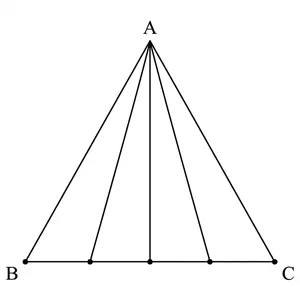
A triangle ABC has 3 lines drawn from the apex A to the base BC, which splits the base into 4 equal segments. How many triangles are there in the figure?
Solution
Step 1: Label the smallest triangles.
The 3 lines from A divide the triangle into 4 thin triangles. Call them 1, 2, 3 and 4, from left to right.
Step 2: Count triangles made of 1 part.
1, 2, 3, 4 gives 4 triangles.
Step 3: Count triangles made of 2 adjacent parts.
(1+2), (2+3), (3+4) gives 3 triangles.
Step 4: Count triangles made of 3 adjacent parts.
(1+2+3), (2+3+4) gives 2 triangles.
Step 5: Count triangles made of 4 parts.
(1+2+3+4), the whole triangle ABC, gives 1 triangle.
Step 6: Add the running total.
4 + 3 + 2 + 1 = 10
Answer: 10
What Skills Do These Questions Measure?
Analytical reasoning questions test your ability in:
👉 Systematic observation and analysis – working through a figure methodically rather than randomly
👉 Spatial visualization and mental rotation – picturing how a shape looks when rotated or reflected
👉 Attention to detail – catching every shape, including ones hidden in overlaps
👉 Pattern recognition – spotting the rule that governs a sequence of figures
👉 Logical and analytical thinking – breaking a complex diagram into manageable parts
👉 Systematic counting and categorization – tracking counts accurately across shape sizes and groups
👉 Speed and accuracy – solving visually dense problems within exam time limits
This topic is part of the Non-Verbal Reasoning Test in the Officer Cadet syllabus and is a high-scoring area because questions follow predictable patterns and test fundamental cognitive abilities.
Important Terms and Definitions
👉 Analytical reasoning (non-verbal) – the systematic analysis of visual figures to count shapes, identify patterns, and solve spatial problems
👉 Counting of figures – systematically counting how many of a specific shape appear in a complex figure
👉 Spatial visualization – the ability to mentally manipulate, rotate, and transform objects in space
👉 Figure matrix – a rectangular grid of figures that follow a specific rule, with one figure missing for you to identify
👉 Embedded figure – a simple shape hidden within a larger, more complex figure
👉 Grouping of identical figures – identifying figures that share common properties or belong to the same category
👉 Mirror image – the reflection of a figure as seen in a mirror, where left and right are reversed
👉 Water image – the reflection of a figure as seen in water, where top and bottom are reversed
Types of Analytical Reasoning Questions
For Officer Cadet preparation, analytical reasoning questions may involve:
1. Counting of figures
Counting of figures involves identifying and counting the number of triangles, squares, rectangles, and parallelograms within a complex diagram.
Counting of Figures: Key Principles
Always count shapes systematically rather than randomly, since a structured method prevents missed or double-counted shapes. Break complex figures into simpler components, count the shapes within each, and combine the totals. Label different parts of the figure as you go so you can track exactly what’s already been counted, and stay alert for shapes that share a line or overlap with another shape, since these are the easiest to double-count.
Counting of Triangles
Question
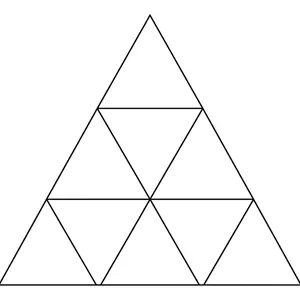
A large triangle has each side divided into 3 equal parts, and lines are drawn parallel to the sides to form a grid of 9 small triangles. How many triangles are there in the figure?
Solution
Step 1: Count the smallest triangles (side 1).
Pointing up: 1 + 2 + 3 = 6
Pointing down: 0 + 1 + 2 = 3
Total = 9
Step 2: Count the triangles with side 2.
These all point up, and there are 3 of them (one at the top, two along the bottom).
No downward triangle of side 2 fits in a grid of side 3.
Step 3: Count the triangles with side 3.
Only the whole triangle, so 1.
Step 4: Add every size category.
9 + 3 + 1 = 13
Answer: 13
Counting of Squares
Question
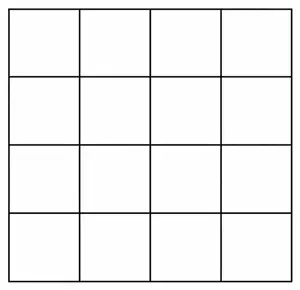
A square is divided into a 4 × 4 grid of 16 equal small squares. How many squares of all sizes are there in the figure?
Solution
Step 1: Count the 1 × 1 squares.
There are 4 rows and 4 columns, so 4 × 4 = 16.
Step 2: Count the 2 × 2 squares.
A 2 × 2 square can start in 3 positions across and 3 positions down, so 3 × 3 = 9.
Step 3: Count the 3 × 3 squares.
There are 2 positions across and 2 down, so 2 × 2 = 4.
Step 4: Count the 4 × 4 squares.
Only the whole figure, so 1.
Step 5: Add every size category.
16 + 9 + 4 + 1 = 30
Answer: 30
Shortcut check: For an n × n grid, the total is 1² + 2² + 3² + … + n² = n(n + 1)(2n + 1) ÷ 6. With n = 4: 4 × 5 × 9 ÷ 6 = 180 ÷ 6 = 30
Counting of Rectangles and Parallelograms
Question
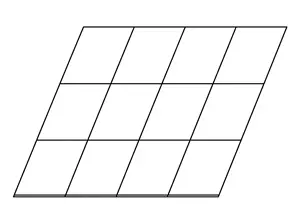
A large parallelogram is divided into 3 rows and 4 columns of equal small parallelograms by lines drawn parallel to its sides. How many parallelograms of all sizes are there in the figure?
Solution
Step 1: Count the lines in each direction (including boundaries).
3 rows need 3 + 1 = 4 lines in one direction. Call this m.
4 columns need 4 + 1 = 5 lines in the other direction. Call this n.
Step 2: Apply the formula.
Total = mC2 × nC2 = 4C2 × 5C2
Step 3: Calculate each part.
4C2 = (4 × 3) ÷ 2 = 6
5C2 = (5 × 4) ÷ 2 = 10
Step 4: Multiply.
6 × 10 = 60
Answer: 60
2. Figure Matrix Completion
Figure matrix completion involves finding the missing figure that fits the pattern in a given row or column.
Figure Matrix: Key Principles
Look at rows first, then columns, identifying changes such as rotation, number, shape, or shading. Figures can change in multiple ways at once — shape, count, rotation, shading, and position — so isolate one feature at a time. Whatever rule governs the pattern should apply consistently across every row and column.
Question
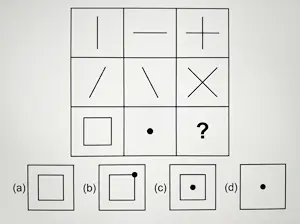
Select the figure that completes the matrix.
Solution
Step 1: Study Row 1.
A vertical line + a horizontal line = a plus sign. The third figure is the first two drawn on top of each other.
Step 2: Check the rule on Row 2.
“/” + “” = “X”. The same rule holds.
Step 3: Check the columns.
The columns show no consistent rule (a vertical line, a “/” and a square have nothing in common), so the rule works across rows.
Step 4: Apply the rule to Row 3.
A square outline + a dot in the center = a square outline with a dot at its center.
Answer: (c) A square outline with a dot at its center
3. Embedded Figures
Embedded figures involve locating a simple shape that is hidden within a larger, more complex figure.
Embedded Figures: Key Principles
The question figure must be an actual, integral part of the answer figure — not just something that looks superficially similar. The question figure may appear rotated at any angle within the answer options, and answer figures often contain deliberately similar shapes or lines designed to distract you from the real match.
Question
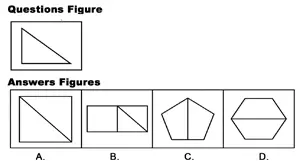
The question figure is a right-angled triangle with a short vertical side on the left, a horizontal base along the bottom, and a slanted side joining them. Which answer figure contains this triangle, at the same size and orientation, as part of it?
(a) A large square with one diagonal line from its top-left corner to its bottom-right corner
(b) A rectangle with a vertical line dividing it in half, and a diagonal line from the top of the dividing line to the bottom-right corner
(c) A pentagon with a vertical line from its top vertex to the center of its base
(d) A hexagon with a horizontal line through the middle
Solution
Step 1: Trace the target.
It has one right angle (between the vertical side and the base), and two acute angles. The vertical side is about half the length of the base.
Step 2: Note the unique features.
A right angle at the bottom left, with a vertical side on the left and a horizontal base.
The slanted side rises from the bottom right up to the top of the vertical side, so the vertical side is shorter than the base.
Step 3: Eliminate options.
(a) The diagonal forms right triangles, but the vertical and horizontal sides are equal, so the proportions don’t match.
(c) The vertical line meets the base at a right angle, but the slanted sides leave the top vertex at different angles, and the base is not twice the height.
(d) A horizontal line through a hexagon creates no right angle at all.
Step 4: Confirm the match.
In (b), the vertical dividing line and the bottom edge form a right angle. The diagonal from the top of that line to the bottom-right corner closes the triangle. The vertical side is half the base, matching the target.
Answer: (b)
4. Grouping of Identical Figures
Grouping of identical figures involves sorting figures into categories based on their shared properties.
Question
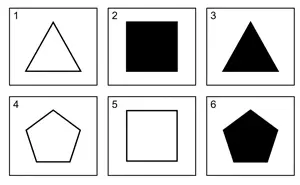
Six figures are given below. Group them into three classes.
1. Triangle, unshaded
2. Square, shaded
3. Triangle, shaded
4. Pentagon, unshaded
5. Square, unshaded
6. Pentagon, shaded
Which option shows the correct grouping?
(a) {1, 3}, {2, 5}, {4, 6}
(b) {1, 4}, {2, 5}, {3, 6}
(c) {1, 2}, {3, 4}, {5, 6}
(d) {1, 5}, {2, 6}, {3, 4}
Solution:
Confirm every figure is placed exactly once.
All six figures (1, 2, 3, 4, 5, 6) appear once, in three groups of two. ✓
Answer: (a) {1, 3}, {2, 5}, {4, 6}
Why the other options fail:
(b) mixes triangles and pentagons in the first group.
(c) and (d) each pair figures with different numbers of sides.
5. Mirror Images
Mirror images involve identifying how a figure appears when it is reflected in a mirror.
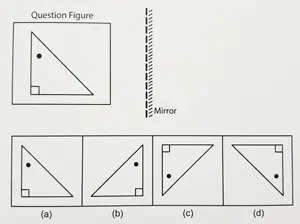
Question
The question figure is a right-angled triangle with its right angle at the bottom-left corner. A small dot sits inside the triangle, near the top of the vertical side. A mirror is placed vertically on the right side of the figure. Which option shows its mirror image?
(a) Right angle at the bottom-left, dot near the top of the vertical side
(b) Right angle at the bottom-right, dot near the top of the vertical side
(c) Right angle at the top-left, dot near the bottom of the vertical side
(d) Right angle at the top-right, dot near the bottom of the vertical side
Solution
Step 1: Decide what the mirror reverses.
The mirror is vertical, so it reverses left and right. Top and bottom stay where they are.
Step 2: Track each feature.
The right angle is at the bottom-left, so it moves to the bottom-right (still at the bottom).
The vertical side is on the left, so it moves to the right.
The dot is near the top of the vertical side, so it stays near the top, now next to the vertical side on the right.
Step 3: Compare with the options.
(a) is the original figure, unchanged.
(c) reverses top and bottom as well as left and right, which is wrong.
(d) is the original rotated by 180°, which is not a mirror image.
(b) matches every feature.
Answer: (b)
6. Water Images
Water images involve identifying how a figure appears when it is reflected in water.
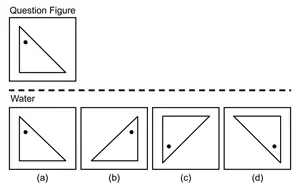
Question
The question figure is a right-angled triangle with its right angle at the bottom-left corner. A small dot sits inside the triangle, near the top of the vertical side. Which option shows its water image?
(a) Right angle at the bottom-left, dot near the top of the vertical side
(b) Right angle at the bottom-right, dot near the top of the vertical side
(c) Right angle at the top-left, dot near the bottom of the vertical side
(d) Right angle at the top-right, dot near the bottom of the vertical side
Solution
Step 1: Decide what the water reverses.
The water surface is horizontal, so it reverses top and bottom. Left and right stay the same.
Step 2: Track each feature.
The right angle is at the bottom-left, so it moves to the top-left (still on the left).
The vertical side stays on the left.
The dot is near the top of the vertical side, so it moves to near the bottom of the vertical side.
Step 3: Compare with the options.
(a) is the original figure, unchanged.
(b) reverses left and right, which is a mirror image, not a water image.
(d) reverses both left-right and top-bottom, which is a 180° rotation.
(c) matches every feature.
Answer: (c) Right angle at the top-left, dot near the bottom of the vertical side
7. Cubes and dice
Cubes and dice involve counting the number of cubes in a stack or identifying the opposite and hidden faces of a dice.
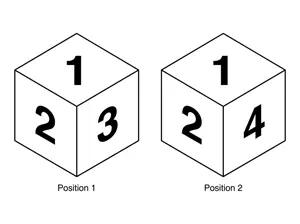
Question
Two positions of the same dice are shown. In the first, the visible faces are 1, 2 and 3. In the second, the visible faces are 1, 2 and 4. Which number is opposite to 3?
Solution
Step 1: Find the faces common to both views. Faces 1 and 2 appear in both.
Step 2: If two faces are common, the remaining visible faces (3 in the first view and 4 in the second) must be opposite each other. They can’t touch 1 and 2 in the same way in both views unless they are on opposite sides.
Step 3: So 3 is opposite 4.
Answer: 4
Question:
A 3 × 3 × 3 cube is painted red on all its outer faces and then cut into 27 equal small cubes. How many small cubes have exactly two faces painted?
Solution
Step 1: Cubes with two painted faces are the edge cubes (not corners).
Step 2: A cube has 12 edges, and each edge of a 3 × 3 × 3 cube has 3 − 2 = 1 such cube.
Step 3: 12 × 1 = 12
Answer: 12
How to Solve Analytical Reasoning Questions
Follow this step-by-step method during your exam.
Step 1: Read the Question Carefully
Identify which type of analytical reasoning question you’re facing — counting of figures, a figure matrix, embedded figures, grouping, or mirror/water images — since each requires a different approach.
Step 2: For Counting Figures, Use a Systematic Approach
Label all the smaller shapes or regions in the figure, count shapes by size category (single unit, two units, three units, and so on), add all the counts together, and verify by counting again in a different order.
Step 3: For a Figure Matrix, Analyze the Pattern
Look at rows first, then columns, identifying one feature at a time — rotation, number, shape, or shading — and apply the rule you find to determine the missing figure.
Step 4: For Embedded Figures, Look for Unique Features
Trace the outline of the small figure, look for its sharpest or most distinct angle first, and eliminate any option that doesn’t contain even a single matching angle.
Step 5: Verify Your Answer
Check that your answer makes logical sense and satisfies every condition stated in the question.
Step 6: Manage Your Time
If a question is taking too long, mark it, move on, and return later if time allows: Solve → Mark if necessary → Move on → Return later.
Effective Tricks to Solve Analytical Reasoning Questions
Trick 1: Use the Component Method for Triangles
Break the figure into smaller components, count the triangles within each component separately, and then add the totals together.
Trick 2: Use the Formula for Counting Squares
For an n×n grid of squares, the total number of squares equals 1² + 2² + 3² + … + n².
Trick 3: Use the Formula for Counting Rectangles
For a grid with m lines in one direction and n lines in another, the total number of rectangles equals (mC2) × (nC2) = [m(m−1)/2] × [n(n−1)/2].
Trick 4: Look for the Sharpest Angle First
In embedded figure questions, the rarest or sharpest angle of the small figure is usually the fastest one to spot in the answer options.
Trick 5: Eliminate Using Angles
Rule out any option that doesn’t contain at least one matching angle to the question figure.
Trick 6: Count Sides for Quick Elimination
A shape with more sides can never hide inside a shape with fewer — a pentagon can never be embedded in a quadrilateral, for instance.
Trick 7: Use the Clockwise-Corner Rule
Label the corners of the small figure and look for that same sequence of corners, in the same order, within the answer figure.
Trick 8: Trace the Outline Physically
Trace the small figure with a pen or finger directly on the page to help visualize it inside the larger figure.
Trick 9: Solve Figure Matrix Features Independently
When multiple features change at once — shape, orientation, shading, position, and count — solve for each one separately rather than trying to track them all simultaneously.
Trick 10: Use the Left-Right Rule for Mirror Images
In a mirror image, left becomes right and right becomes left, while the top and bottom remain unchanged.
Important Tips to Solve Analytical Reasoning Questions
Common Mistakes to Avoid
👉 Counting randomly — this leads to missed or double-counted shapes; always use a systematic, labeled approach
👉 Skipping labels — without labeling parts of the figure, it’s easy to lose track of what’s already been counted
👉 Forgetting larger shapes — shapes of multiple sizes are often present; count every size category, not just the smallest units
👉 Double-counting overlapping shapes — shapes that share a line are easy to count twice; slow down around overlaps
👉 Ignoring rotation in embedded figures — the question figure may appear rotated, so don’t rule out an option just because its orientation looks different
👉 Checking only one feature in a figure matrix — figures often change in several ways at once, so verify every feature independently before settling on an answer
Quick Solving Checklist
Before selecting your answer, use this checklist:
👉 Identified the type of analytical reasoning question
👉 Labeled parts of the figure and counted systematically (for counting questions)
👉 Analyzed rows and columns for the governing rule (for figure matrix questions)
👉 Traced the outline and looked for unique features (for embedded figures)
👉 Considered rotations and reflections where applicable
👉 Eliminated options that clearly don’t match
👉 Verified the answer makes logical sense
👉 Avoided spending too much time on one question
Practice Questions
Conclusion
Mastering the Analytical Reasoning Test is essential for the Nepal Army Officer Cadet Entrance Examination. Success requires systematic observation, careful counting, and logical analysis — not guesswork — across scenarios involving counting of figures, figure matrices, embedded figures, mirror and water images, and grouping of figures.
Follow this disciplined approach:
Analyze → Systematize → Count/Identify → Verify → Answer
Regular practice enhances pattern recognition, spatial awareness, speed, and accuracy — skills that matter for officers who must quickly analyze complex situations, identify patterns, and make accurate decisions under pressure.
This resource is part of the Officer Cadet Entrance Exam Preparation series, focusing on IQ and Logical Reasoning for the Nepal Army Officer Cadet Entrance Exam. For structured lessons, comprehensive practice banks, and mock tests, explore the Analytical Reasoning Test subtopic under the Non-Verbal Reasoning topic in the IQ and Logical Reasoning course on the Pratima Academy LMS.