
Geometry is an important part of Mathematics that covers theorems and problems related to triangles, circles, tangents, and geometric constructions. It includes theorems related to the area of triangles, relationships among central angles, inscribed angles, and cyclic quadrilaterals, as well as problems involving the relationship between the radius and tangent of a circle. It also covers experimental verification of circle theorems and the construction of triangles and quadrilaterals with equal areas.
For Officer Cadet Entrance Exam preparation, geometry questions help develop spatial reasoning, theorem-based problem-solving, and the ability to apply geometric principles accurately. This resource covers essential geometry theorems, solving methods, useful tricks, constructions, and practice questions related to triangles, circles, tangents, cyclic quadrilaterals, and equal-area constructions. Explore the complete Officer Cadet Exam resources and Maths for Officer Cadet for additional practice and study materials.
What is Geometry for Officer Cadet?
Geometry is the branch of mathematics that deals with the study of shapes, sizes, angles, areas, and spatial relationships. It emphasizes logical reasoning, theorems, proofs, and practical construction — skills essential for tactical decision-making, map reading, engineering tasks, and leadership in the field.
Main Branches of Geometry
👉 Plane Geometry – Deals with flat, 2D shapes like triangles, circles, squares, and polygons.
👉 Solid Geometry – Deals with 3D shapes like cubes, prisms, cylinders, spheres, and cones.
👉 Coordinate Geometry – Uses a coordinate system (x, y axes) to study shapes and their equations.
👉 Analytical Geometry – Combines algebra and geometry using coordinates.
👉 Differential Geometry – Studies curves and surfaces using calculus.
👉 Non-Euclidean Geometry – Explores geometries where Euclid’s parallel postulate doesn’t hold (e.g., spherical, hyperbolic).
Basic Concepts in Geometry
👉 Point – A location with no size (0 dimensions)
👉 Line – A straight path extending infinitely in both directions (1 dimension)
👉 Plane – A flat surface extending infinitely (2 dimensions)
👉 Angle – Formed by two rays meeting at a point
👉 Polygon – A closed 2D shape with straight sides (triangle, square, pentagon, etc.)
👉 Solid – A 3D object (cube, prism, sphere, etc.)
Why Geometry for an Officer Cadet?
Geometry plays a vital role in an officer cadet’s training. Map reading and navigation depend on angles, bearings, and distances derived from circle and triangle geometry. Field engineering — such as constructing bridges, bunkers, and camps — requires accurate area and volume calculations. Tactical planning uses equal-area constructions and angle relationships to position and divide terrain effectively. Logical reasoning, developed through geometric proofs, trains the mind to think step-by-step — a core military skill. Finally, artillery and surveying apply tangent and circle theorems for range finding and observation.
Geometry for Officer Cadet: Syllabus
This Mathematics for Officer Cadet Entrance Exam Preparation resource covers the following main topics:
1. Proofs of theorems related to the area of a triangle and a parallelogram
2. Circle: problems on the relationship between central angles, inscribed angles, and cyclic quadrilaterals
3. Problems on tangents: the relationship between the radius and a tangent only
4. Experimental verification: central angle, inscribed angle, and opposite angles of a cyclic quadrilateral
5. Construction of triangles and quadrilaterals with equal area
1. Area of a Triangle and Parallelogram: Theorems
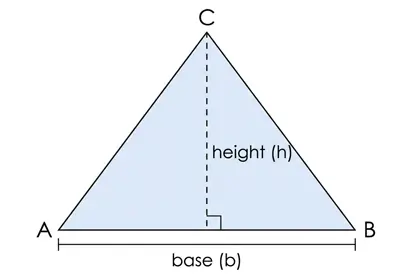
Theorem 1:
The area of a triangle is equal to half the product of its base and height.
Area of △ ABC = ½ × base × height = b×h
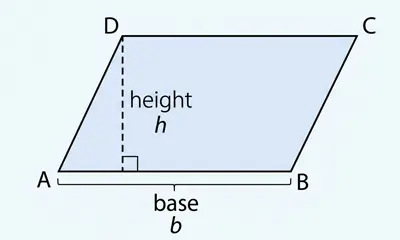
Theorem 2:
The area of a parallelogram is equal to the product of its base and height.
Area of parallelogram ABCD = base × height = bxh
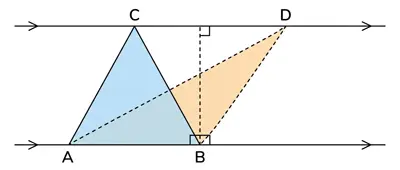
Theorem 3:
Triangles on the same base and between the same parallels are equal in area.
Area of △ ABC = Area of △ ABD
Theorem 4:
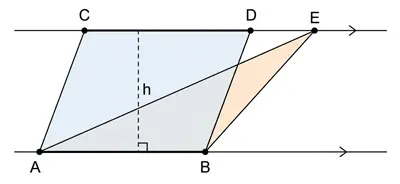
A triangle and a parallelogram on the same base and between the same parallels are such that the area of the triangle is half the area of the parallelogram.
Area of △ ABE = ½ × Area of parallelogram ABDC
Theorem 5:
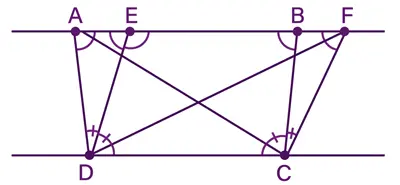
Parallelograms on the same base and between the same parallels are equal in area.
Area of parallelogram ABCD = Area of parallelogram EDCF
Trick: Whenever you see “same base and between the same parallels” in a question, immediately think equal areas — this phrase is the exam’s biggest hint, and most proof-based questions in this section hinge on recognizing it quickly.
2. Circle: Theorems
Theorem 1:
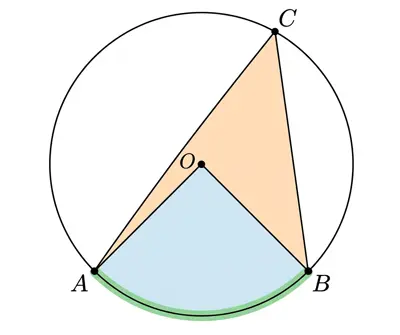
The angle subtended by an arc at the center of a circle is twice the angle subtended by the same arc at any point on the remaining part of the circle.
If an arc subtends an angle θ at the center, it subtends θ/2 at any point on the major arc.
<AOB = 2×<ACB
Theorem 2:
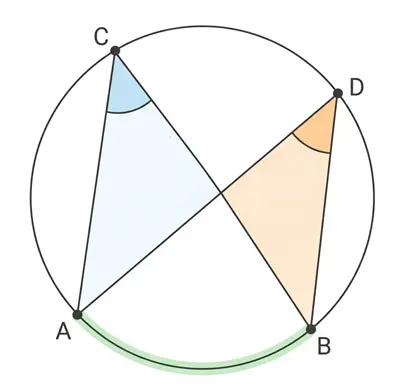
Angles subtended by the same arc in the same segment of a circle are equal.
<ACB = <ADB
Theorem 3:
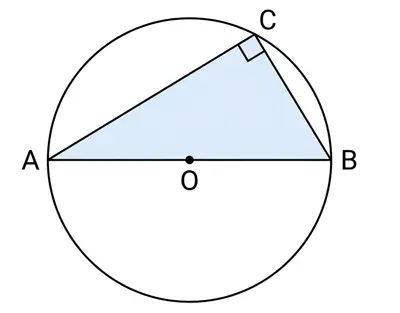
The angle subtended by a diameter at any point on the circle is a right angle (90°).
<ACB = 90°
Theorem 4:
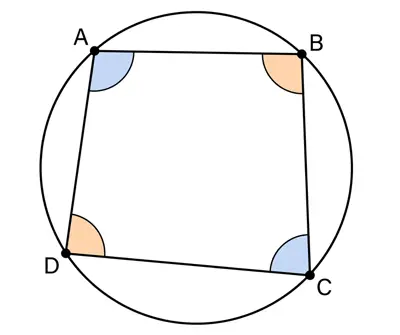
The sum of opposite angles of a cyclic quadrilateral is 180°.
If ABCD is a cyclic quadrilateral, then ∠A + ∠C = 180° and ∠B + ∠D = 180°.
Trick: Remember the shortcut “central angle = 2 × inscribed angle” as your starting point — most circle problems can be solved by first identifying the central angle and inscribed angle relationship, then using the cyclic quadrilateral property if four points are involved.
3. Tangent and Radius Relationship
Theorem:
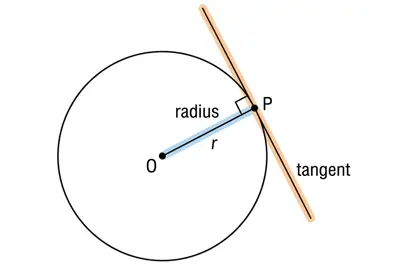
A tangent to a circle is perpendicular to the radius drawn at the point of contact.
radius ⊥ tangent (<OPT = 90°)
If a line touches a circle at exactly one point (the point of tangency), the radius drawn to that point always makes a 90° angle with the tangent line.
Key applications:
- Used to find unknown lengths in right triangles formed by the radius, tangent, and a line from the external point to the center.
- Two tangents drawn from the same external point to a circle are equal in length.
Trick: Whenever a tangent and radius appear together in a diagram, immediately mark the 90° angle at the point of contact — this converts the problem into a right-triangle problem, which is usually much easier to solve using the Pythagorean theorem.
4. Experimental Verification of Angle Properties
Geometry is not just about memorizing theorems — it is about discovering and confirming them through practical work. Experimental verification is the process of drawing geometric figures, measuring angles and lengths with instruments, and confirming that the theoretical results hold true.
This section focuses on verifying geometric theorems practically, typically through construction and measurement:
- Central angle and inscribed angle: Draw a circle, mark an arc, measure the angle it subtends at the center and at a point on the circle, and confirm the central angle is double the inscribed angle.
- Opposite angles of a cyclic quadrilateral: Draw a cyclic quadrilateral, measure each pair of opposite angles, and confirm they sum to 180°.
Trick: For experimental verification questions, always double-check your protractor readings against the theorem’s expected relationship (e.g., central = 2 × inscribed) rather than trusting a single measurement — small drawing errors are common, and understanding the expected relationship helps you catch mistakes.
5. Construction of Triangles and Quadrilaterals of Equal Area
Constructing a triangle equal in area to a given quadrilateral:
- Draw the given quadrilateral ABCD.
- Draw a diagonal (say AC) to divide it into two triangles.
- Through one vertex (say D), draw a line parallel to the diagonal AC, meeting the extension of a side at a point E.
- Join AE — triangle ABE now has the same area as quadrilateral ABCD.
Constructing a triangle equal in area to a given triangle but with a different base:
- Use the same base-and-parallel principle: keep the base fixed and draw the new triangle’s vertex on a line parallel to the base, passing through the original apex.
Trick: All “equal area” constructions in this section rely on one core idea — moving a vertex along a line parallel to the base does not change a triangle’s area. Master this single principle, and most construction problems become straightforward.
Key Takeaways for Exam Day
- Always look for the phrase “same base and between the same parallels” — it is the fastest route to proving equal areas in triangle and parallelogram problems.
- In circle problems, start by identifying the central angle and inscribed angle relationship before applying the cyclic quadrilateral rule.
- Whenever a tangent is involved, immediately mark the 90° angle between the tangent and radius — this converts most tangent problems into straightforward right-triangle calculations.
- For construction-based “equal area” problems, remember that moving a vertex along a line parallel to the base never changes a triangle’s area — this single idea underlies nearly every construction technique in this section.
- Practice experimental verification questions carefully, and always compare your measured results against the theorem’s expected relationship to catch small errors.
Conclusion
Geometry is a conceptually rich and logic-driven topic in the mathematics syllabus for Officer Cadet Entrance Exam preparation. Most geometry questions can be solved efficiently once you have a solid grasp of the core theorems — relating to the area of triangles and parallelograms, the properties of circles, central and inscribed angles, cyclic quadrilaterals, and the relationship between a radius and a tangent. Focus on understanding the logical proofs behind each theorem rather than memorizing them mechanically, practice applying angle and area relationships to solve problems quickly, and strengthen your construction skills for triangles and quadrilaterals of equal area. With regular practice, geometry questions can become a strong and reliable scoring area in the Mathematics section.
This resource is part of the Officer Cadet Entrance Exam Preparation series, focusing on Maths for Officer Cadet Entrance Exam. For structured lessons, comprehensive practice question banks, and mock tests, explore the Geometry for Officer Cadet section of the Maths for Officer Cadet Entrance Exam course on the Pratima Academy LMS.