
Mensuration is an important part of Mathematics that covers the measurement of surface area and volume of different three-dimensional shapes. It includes problems involving the lateral and total surface area and volume of an equilateral triangular-base prism, as well as the curved surface area, total surface area, and volume of a cylinder and sphere. It also covers problems related to the area and volume of a square-based pyramid.
For Officer Cadet Entrance Exam preparation, mensuration questions help develop the ability to apply geometric formulas and solve problems involving dimensions, surface areas, and volumes accurately. This resource covers essential mensuration formulas, solving methods, useful tricks, and practice questions related to prisms, cylinders, spheres, and square-based pyramids. Explore the complete Officer Cadet Exam resources and Maths for Officer Cadet for additional practice and study materials.
what is Mensuration?
Mensuration is the branch of mathematics concerned with measuring geometric figures — their length, area, surface area, volume, and perimeter.
Two main categories:
2D mensuration — deals with flat shapes like squares, rectangles, triangles, and circles. The key measurements here are area and perimeter.
3D mensuration — deals with solid shapes like cubes, cylinders, spheres, cones, prisms, and pyramids. The key measurements here are surface area (curved and total) and volume.
Core concepts it covers:
- Perimeter — the total length around the boundary of a 2D shape.
- Area — the amount of space enclosed within a 2D shape.
- Surface Area — the total area covering the outer surface of a 3D shape (often split into curved/lateral surface area, which excludes flat ends, and total surface area, which includes them).
- Volume — the amount of three-dimensional space a solid object occupies.
Why it matters for Officer Cadet:
Mensuration questions test your ability to apply memorized formulas accurately and quickly — for example, calculating the volume of a cylinder, the total surface area of a pyramid, or working backward from a given volume to find a missing dimension (as in some of the practice questions above). It’s a high-scoring topic because the formulas are fixed and predictable, unlike topics that require more open-ended reasoning.
Mensuration for Officer Cadet: Syllabus
This Mathematics for Officer Cadet Entrance Exam Preparation resource covers the following main topics:
1. Problems on lateral surface area, total surface area, and volume of a prism with an equilateral triangular base
2. Problems on curved surface area, total surface area, and volume of a cylinder and a sphere
3. Problems on the area and volume of a pyramid with a square base
1. Prism (Equilateral Triangular Base)
A prism with an equilateral triangular base is a 3D shape that has two identical equilateral triangles as its top and bottom bases, with three rectangles connecting them.
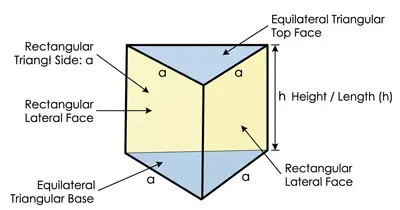
For a prism whose base is an equilateral triangle of side a, and whose height (length of the prism) is h:
- Area of the triangular base = (√3/4) × a²
- Perimeter of the base = 3a
- Lateral Surface Area (LSA) = Perimeter of base × height = 3ah
- Total Surface Area (TSA) = LSA + 2 × (Area of base) = 3ah + (√3/2)a²
- Volume = Area of base × height = (√3/4) × a² × h
Trick: Since the two triangular ends are identical, always double the base area only once, then add it to the lateral part. Students commonly forget to double the base area — check this first if your TSA answer looks too small.
2. Cylinder
A cylinder is a 3D shape that has two identical circles as its top and bottom bases, with a curved surface connecting them.
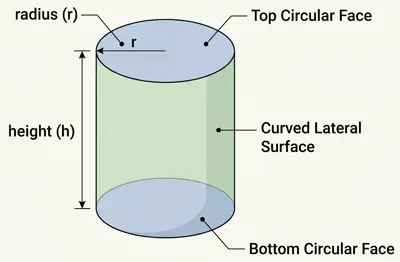
For a cylinder of radius r and height h:
- Curved Surface Area (CSA) = 2πrh
- Total Surface Area (TSA) = 2πr(h + r)
- Volume = πr²h
Trick: TSA is just CSA + area of the two circular ends (2πr²). Memorize TSA as one formula — 2πr(h+r) — instead of adding two separate terms; it saves time and avoids arithmetic slips. Use π = 22/7 when the radius is a multiple of 7, and π = 3.14 otherwise.
3. Sphere and Hemisphere
A sphere is a 3D shape that is perfectly round, with every point on its surface located at an equal distance from its center point.
A hemisphere is a 3D shape formed by cutting a sphere exactly in half, giving it one flat circular base and one curved dome-shaped surface.
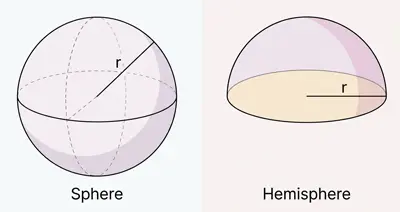
For a sphere of radius r:
- Surface Area = 4πr²
- Volume = (4/3)πr³
For a hemisphere of radius r:
- Curved Surface Area (CSA) = 2πr²
- Total Surface Area (TSA) = 3πr² (curved part + flat circular base)
- Volume = (2/3)πr³
4. Pyramid with a Square Base
A pyramid with a square base is a 3D shape that has a square as its base, with four triangular faces that rise up from each side of the square and meet at a single point called the apex.
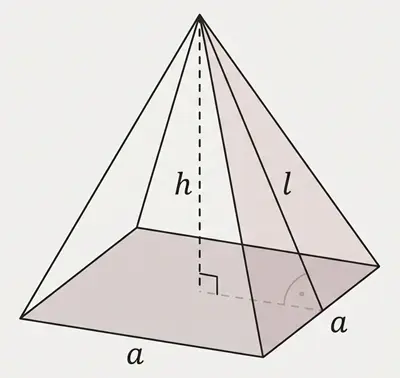
For a pyramid with square base side a, vertical height h, and slant height l (the slant height of each triangular face, measured from the apex to the midpoint of a base edge):
- Base Area = a²
- Lateral Surface Area = 2al (since there are 4 triangular faces, each of area ½ × a × l)
- Total Surface Area = a² + 2al
- Volume = (1/3) × a² × h
- Relation between h, l, and a: l² = h² + (a/2)²
Trick: If a question gives the slant edge (apex to a base corner, not to a base edge midpoint) instead of the slant height, use a different right triangle: (slant edge)² = h² + (a√2/2)², since the base corner is at a distance a/√2 × √2… more precisely, the distance from the center of the square base to a corner is (a√2)/2. Always check whether “slant height” or “slant edge” is specified before applying a formula.
Quick Revision Table
| Shape | Lateral/Curved Surface Area | Total Surface Area | Volume |
|---|---|---|---|
| Equilateral triangular prism | 3ah | 3ah + (√3/2)a² | (√3/4)a²h |
| Cylinder | 2πrh | 2πr(h+r) | πr²h |
| Sphere | — | 4πr² | (4/3)πr³ |
| Hemisphere | 2πr² | 3πr² | (2/3)πr³ |
| Square pyramid | 2al | a² + 2al | (1/3)a²h |
Practice Questions
Conclusion
Mensuration is a high-scoring and formula-driven topic in the mathematics syllabus for Officer Cadet Entrance Exam preparation. Most mensuration questions can be solved efficiently once you can correctly identify the shape involved — prism, cylinder, sphere, hemisphere, or pyramid — and apply the matching surface area or volume formula. Focus on memorizing the core formulas, practice distinguishing between curved and total surface area, and pay close attention to which dimension (vertical height, slant height, or slant edge) is given in a question. With regular practice, mensuration questions can become a quick-scoring area in the Mathematics section.
This resource is part of the Officer Cadet Entrance Exam Preparation series, focusing on Maths for Officer Cadet Entrance Exam. For structured lessons, comprehensive practice question banks, and mock tests, explore the Mensuration for Officer Cadet section of the Maths for Officer Cadet Entrance Exam course on the Pratima Academy LMS.