

Pattern Completion and Figure Formation Test is an important part of IQ and Logical Reasoning that tests your ability to recognize visual patterns, identify missing elements, and mentally combine shapes to form complete figures.
For Officer Cadet Entrance Exam preparation, these questions help develop spatial visualization, pattern recognition, observation, and analytical reasoning skills. Explore the complete Officer Cadet Exam resources and IQ for Officer Cadet preparation for additional practice and study materials.
- What are Pattern Completion and Figure Formation?
- What Skills Do These Questions Measure?
- Important Terms and Definitions
- Pattern Completion: Fundamental Concepts
- Figure Formation: Fundamental Concepts
- Common Pattern Rules
- Types of Pattern Completion and Figure Formation Questions
- How to Solve Pattern Completion Questions
- How to Solve Figure Formation Questions
- Effective Tricks to Solve These Questions
- Important Tips to Solve These Questions
- Practice Questions
- Conclusion
- Related Resources
What are Pattern Completion and Figure Formation?
Pattern Completion
Pattern Completion questions require you to identify the missing part of a figure by recognizing patterns, symmetry, repetition, and geometric transformations.
Question:
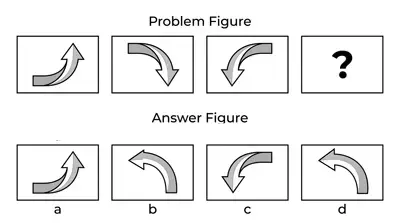
Look at the three problem figures and identify the figure that should replace the question mark to complete the pattern.
Solution:
The arrow rotates 90° clockwise from one figure to the next: up-right → down-right → down-left → up-left. Therefore, the missing figure must point up-left.
Answer: Option d.
Figure Formation
Figure Formation questions test your ability to identify how smaller pieces combine to form a complete figure or which pieces can form a given figure.
Question:
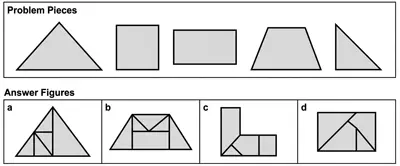
The pieces shown below can be joined together to form one of the answer figures. Identify the answer figure that can be formed by combining all the given pieces without overlapping or leaving any gaps.
Solution:
Examine the shapes and mentally rotate or rearrange the pieces to see how their edges fit together. The pieces combine to form the complete shape shown in Option c.
Answer: Option c.
What Skills Do These Questions Measure?
Pattern completion and figure formation questions test your ability in:
👉 Visual perception and spatial awareness – accurately reading complex figures.
👉 Pattern recognition and analysis – spotting symmetry, repetition, and progression.
👉 Mental rotation and transformation – picturing how a shape looks after rotating or reflecting.
👉 Attention to detail – catching subtle mismatches between a predicted figure and the options.
👉 Analytical and logical reasoning – narrowing down options systematically.
👉 Seeing relationships between parts and wholes – understanding how components combine into a complete figure.
👉 This combined topic is a high-scoring area in the Non-Verbal Reasoning section because questions follow predictable patterns and test fundamental cognitive abilities.
Important Terms and Definitions
👉 Pattern completion – a question type where a part of a figure is missing and you must identify the option that completes it.
👉 Figure formation – creating a defined geometric figure by joining two or more differently designed pieces.
👉 Rotational symmetry – a figure looks the same after being rotated by a certain angle, commonly 90°, 180°, or 360°.
👉 Mirror symmetry (reflection) – one half of a figure is the mirror image of the other half.
👉 Translation – moving a figure from one position to another without rotating or reflecting it.
👉 Spatial visualization – the ability to mentally manipulate, rotate, and transform objects in space.
👉 Matrix – a grid arrangement of figures where a pattern operates across rows and columns.
👉 Distractor – an incorrect option designed to look plausible while violating one or more pattern rules.
Pattern Completion: Fundamental Concepts
Many pattern completion questions rely on rotational or mirror symmetry, where the missing part is a rotated or reflected version of another part in the figure. Figures often contain repeating motifs that recur across the whole design, and the completed figure must always follow the same design rules as the parts already given. Multiple features — shape, orientation, shading, size, and position — can change at once, so it pays to track each one individually.
Figure Formation: Fundamental Concepts
The pieces given in the question must be able to join without gaps or overlaps to form the answer figure, and pieces may be rotated to fit together correctly. The relative sizes and proportions of the pieces must be preserved in the final assembly, and in some questions, boundary lines shown in the answer figures can themselves count as valid pieces.
Common Pattern Rules
| Rule | Description | Example |
|---|---|---|
| 90° Rotation | Figure repeats every 90° | Each quadrant is rotated 90° clockwise |
| 180° Rotation | Diagonally opposite parts are similar | Top-left = Bottom-right |
| Mirror Reflection | Adjacent parts are mirror images | Left = Right, inverted |
| Translation | Elements shift position | A shape moves across the figure |
| Alternation | Elements alternate | Shading alternates in a pattern |
| Progression | Elements change progressively | Size increases, shading darkens |
Types of Pattern Completion and Figure Formation Questions
For Officer Cadet preparation, these questions may involve:
1. 90° Rotational Symmetry
Example:
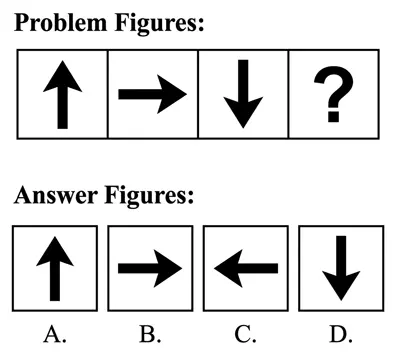
Identify the missing part of the given figure.
Solution:
👉 The first arrow points Up.
👉 The second arrow points Right (rotated 90° clockwise from Up).
👉 The third arrow points Down (rotated 90° clockwise from Right).
👉 Following this pattern, the fourth arrow should point Left (rotated 90° clockwise from Down).
Answer: C
2. 180° Rotational Symmetry
Example:
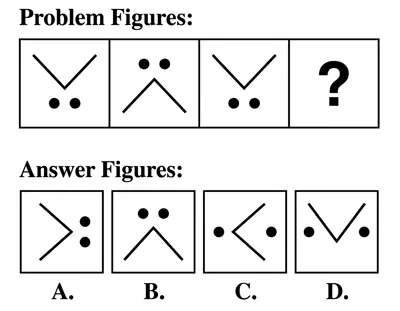
Complete the missing portion of the figure.
Solution:
👉 The 1st figure shows a downward-pointing angle with two dots below it. Rotating this 180° gives an upward-pointing angle with two dots above it, which matches the 2nd figure.
👉 The 3rd figure is identical to the 1st figure (downward-pointing angle with dots below).
👉 Therefore, the missing 4th figure must be identical to the 2nd figure (upward-pointing angle with dots above).
Answer: B
3. Adjacent Parts as Inverted Images
Example:
Identify the figure which completes the pattern.
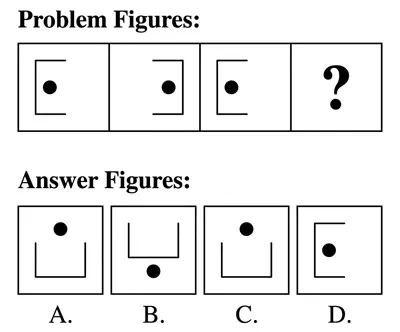
Solution:
👉 Look at the 3rd figure. It is a bracket open to the right with a dot inside.
👉 Following the rule that adjacent parts are inverted versions of each other, the 4th figure must be the vertical inversion (upside-down version) of the 3rd figure.
👉 If you rotate the 3rd figure 180° (or flip it vertically), the bracket will open upwards, and the dot will be positioned above it.
Answer: A
4. Repeating Design Patterns
Example:
Select the figure that completes the pattern.
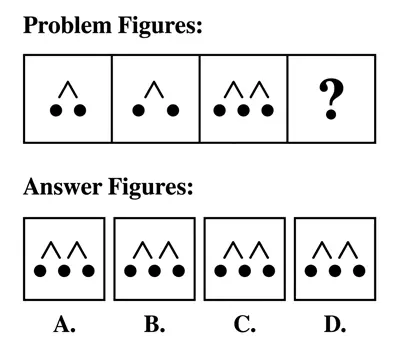
Solution:
👉 The sequence progresses by adding one “roof” and one dot at a time:
👉 1st figure: 1 roof, 2 dots
👉 2nd figure: 1 roof, 2 dots (spaced slightly wider)
👉 3rd figure: 2 roofs, 3 dots
👉 The repeating motif in the final step is indeed the 2-roof, 3-dot design.
👉 The missing 4th figure must simply continue this design, meaning it should look exactly like the 3rd figure.
Answer: C
5. Figure Formation Based on Arrangement
Example:
Find the figure that can be formed by joining the pieces given in the question.
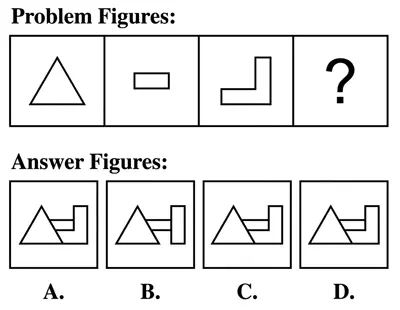
Solution:
👉 Look at the given pieces: a triangle, a rectangle, and an L-shaped block.
👉 The rectangle is long and thin. It must fit horizontally between the triangle and the vertical part of the L-shape.
👉 Check the options:
👉 The rectangle fits perfectly between the pieces with no gaps or overlaps.
Answer: C
6. Figure Formation in Reverse (Signs and Symbols)
Example:
Find the figure among the answer choices whose pieces can form the question figure.
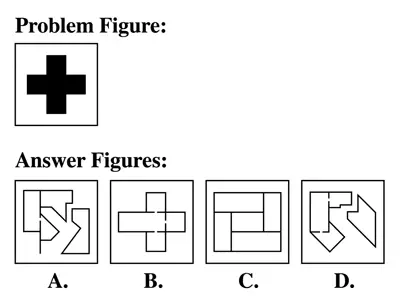
Solution:
👉 Look at the problem figure. It is a solid black cross made of 5 squares.
👉 Check the answer choices to find pieces that fit together to make this exact cross shape without gaps or overlaps.
👉 A, C, and D: Contain diagonal edges or incorrect shapes that cannot form a straight-edged cross.
👉 B: Shows pieces (squares and rectangles) that, when joined along the dashed lines, perfectly assemble into the 5-square cross.
Answer: B
7. Triangle Formation
Example:
Identify the correct combination of three pieces that fit together to form the required triangle.
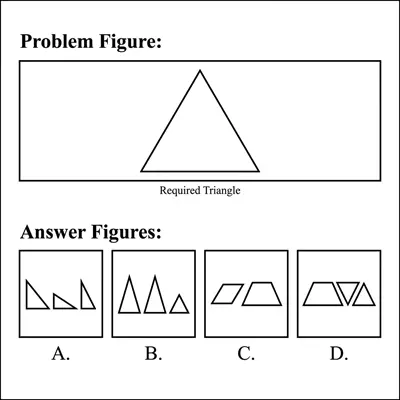
Solution:
👉 Observe the “Required Triangle.” It is a large triangle that must be formed by joining three smaller pieces.
👉 When a large triangle is divided into three pieces by cutting it, the pieces usually consist of two smaller triangles at the bottom corners and one quadrilateral (or triangle) in the middle to bridge them.
👉 Check the answer choices to see which pieces can be arranged and rotated to close the gap:
👉 A & B: These contain multiple separate triangles that would leave gaps when put together.
👉 C: Contains two trapezoids and a parallelogram, which would not form a simple triangle.
👉 D: Contains one trapezoid and two smaller triangles. If you place the trapezoid in the middle and attach the two small triangles to its slanted sides, they perfectly complete the large triangle shape with no gaps.
Answer: D
8. Pattern Completion in a Matrix
Example:
Identify the figure which completes the pattern in the 3×3 matrix.
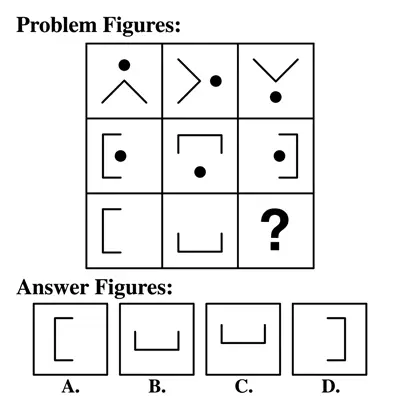
Solution:
👉 Analyze the pattern in the third row. The first figure is a bracket open to the right. The second figure is a bracket open upwards.
👉 Look at the corresponding figures in the first two rows to determine the rule for the third figure.
👉 In the first row, the third figure is the shape from the first figure rotated 180° (upside-down).
👉 In the second row, the third figure is also the shape from the first figure rotated 180°.
👉 Apply this rule to the third row. The missing figure must be the first figure (bracket open to the right) rotated 180°, which results in a bracket open to the left.
Answer: A
How to Solve Pattern Completion Questions
Follow this step-by-step method during your exam.
Step 1: Analyze the Given Figure
Identify the overall design, whether there’s a repeating pattern or motif, whether symmetry is present (rotational or mirror), and exactly where the missing part sits.
Step 2: Identify the Pattern Rule
Check for 90° rotational symmetry (each part is the same design rotated), 180° rotational symmetry (diagonally opposite parts match), mirror symmetry (adjacent parts are inverted), or a simple repeating design.
Step 3: Apply the Rule to Find the Missing Part
Once you’ve identified the governing rule, apply it directly to work out what the missing part should look like.
Step 4: Eliminate Incorrect Options
Rule out any option that clearly conflicts with the rules you observed in the rest of the figure.
Step 5: Verify Your Answer
Confirm that the completed figure follows the exact same design rules as the parts that were already given.
How to Solve Figure Formation Questions
Follow this step-by-step method during your exam.
Step 1: Analyze the Given Pieces
Note what shapes are present, their relative sizes, and how they might realistically fit together.
Step 2: Visualize the Assembly
Mentally arrange the pieces into a complete figure, rotating them as needed to see how they’d connect.
Step 3: Compare with the Answer Options
Match your mental image of the assembled figure against each answer option to find the one that fits.
Step 4: Trace and Verify
Where possible, trace the pieces on paper and try overlaying them on the candidate option to confirm the match.
Step 5: For Reverse Questions
If the question instead asks which option’s pieces could form the given figure, examine each option’s pieces individually and check whether they could be rearranged to match the target figure.
Effective Tricks to Solve These Questions
Trick 1: Quickly Test Simple Transformations
👉 Try rotation, reflection (lateral or vertical), and translation early — most patterns are built from one of these three basic transformations.
Trick 2: Look for Symmetry First
👉 Check for rotational or mirror symmetry, repeating motifs, and the relative orientation of small elements before assuming a more complex rule is at play.
Trick 3: Compare the Missing Part with Known Parts
👉 Line the missing section up against the other parts of the figure to deduce exactly which transformation would produce it.
Trick 4: Eliminate Conflicting Options Early
👉 Rule out any option that clearly breaks a rule you’ve already confirmed elsewhere in the figure.
Trick 5: Solve Features Independently
👉 When shape, orientation, shading, and position all change at once, solve for each feature separately rather than trying to track them all simultaneously.
Trick 6: Watch for Decoy Distractors
👉 A distractor often matches exactly one feature correctly while violating another — always confirm your predicted answer satisfies every changing feature, not just the most obvious one.
Trick 7: Enumerate Every Feature in a Series
👉 For figure series, systematically check the count of sides, count of elements, rotation angle, shading cycle, and position shift rather than eyeballing the whole figure at once.
Trick 8: Use the Clockwise-Corner Rule
👉 Label the corners of the question figure and look for that same sequence of corners, in order, within the answer figure.
Trick 9: Rotate the Known Part Directly
👉 When rotational symmetry is involved, physically (or mentally) rotate a known part by the exact angle required to generate the missing portion.
Trick 10: Visualize Piece Assembly Actively
👉 For figure formation questions, actively picture rotating and rearranging the pieces rather than just eyeballing them in their given orientation.
Important Tips to Solve These Questions
👉 Identify all transformations — a question may involve rotation, reflection, symmetry, shading, movement, or a combination of multiple transformations.
👉 Check the exact rotation angle — carefully determine whether the figure rotates by 90°, 180°, 270°, or another angle before selecting an option.
👉 Pay attention to boundary lines — in figure formation questions, lines along the boundary of the given pieces may form part of the completed figure.
👉 Compare all features — do not choose an option based on a single matching feature; check shape, position, direction, size, shading, and other relevant details.
👉 Look for the simplest consistent rule — identify the pattern that explains all parts of the figure rather than relying on a visually attractive match.
👉 Visualize the complete figure — mentally rotate, reflect, or combine the pieces to determine how they should form the required pattern.
👉 Eliminate incorrect options systematically — remove choices that violate the identified pattern, orientation, symmetry, or arrangement.
👉 Verify the final answer — make sure the completed or assembled figure follows every rule observed in the question.
👉 Avoid unnecessary assumptions — use only the transformations and relationships supported by the given figures.
👉 Manage your time wisely — if a question takes too long, eliminate clearly incorrect options, make the best-supported choice, and move on.
Practice Questions
Conclusion
Mastering the Pattern Completion and Figure Formation Test is essential for the Nepal Army Officer Cadet Entrance Examination. Success requires systematic visual analysis, pattern recognition, and spatial visualization — not guesswork — across scenarios involving rotational symmetry, mirror reflection, repeating designs, and figure assembly.
Follow this disciplined approach:
Analyze → Identify Rule → Apply → Eliminate → Verify → Answer
Regular practice enhances pattern recognition, spatial awareness, speed, and accuracy — skills that matter for officers who must quickly identify patterns, analyze complex visual information, and make accurate decisions under pressure.
This resource is part of the Officer Cadet Entrance Exam Preparation series, focusing on IQ and Logical Reasoning for the Nepal Army Officer Cadet Entrance Exam. For structured lessons, comprehensive practice banks, and mock tests, explore the Pattern Completion and Figure Formation Test subtopic under the Non-Verbal Reasoning topic in the IQ and Logical Reasoning course on the Pratima Academy LMS.