
Missing Character and Matrix Reasoning Test is an important part of IQ and Logical Reasoning that tests your ability to identify patterns, relationships, and rules among numbers, letters, and symbols arranged in different configurations.
For Officer Cadet Entrance Exam preparation, these questions help develop observation, numerical ability, pattern recognition, and logical thinking skills. Explore the complete Officer Cadet Exam resources and IQ for Officer Cadet preparation for additional practice and study materials.
- What is Missing Character and Matrix Reasoning Test?
- What Skills Do These Questions Measure?
- Important Terms and Definitions
- Common Number Patterns
- Alphabet Position Logic
- Matrix Logic
- Types of Missing Character and Matrix Reasoning Questions
- How to Solve These Questions
- Effective Tricks to Solve These Questions
- Important Tips to Solve These Questions
- Practice Questions
- Conclusion
- Related Resources
What is Missing Character and Matrix Reasoning Test?
Missing Character and Matrix Reasoning Test problems require you to identify a missing number, letter, symbol, or figure by discovering the logical rule connecting the given elements. These questions are designed to test your logical reasoning, pattern recognition, analytical thinking, and problem-solving ability.
Missing Character Test
A Missing Character Test is a type of logical reasoning and pattern-recognition question in which one character—such as a number, letter, symbol, or figure—is missing from a sequence, diagram, or arrangement. The given characters follow a specific logical rule, and you must identify the missing character by discovering and applying that rule.
Example:
A, C, E, G, ?
Solution:
The letters increase by two positions in the alphabet:
A → C → E → G → I
Answer: I
Matrix Reasoning Test
A Matrix Reasoning Test is a type of non-verbal or logical reasoning question in which numbers, letters, symbols, or figures are arranged in a grid of rows and columns. One element is missing, and you must identify the correct answer by discovering the logical relationship between the elements.
The pattern may operate across rows, down columns, or in both directions. The relationship can involve addition, subtraction, multiplication, rotation, position, shape, size, or other visual and logical changes.
Example:
Find the missing numbers in the matrix:
| 4 | 3 | ? |
| 8 | 5 | 169 |
| 10 | 9 | ? |
Solution:
Step 1: Identify the pattern using the known row.
Row 2: 8, 5, 169
(8 + 5)2 = 13² = 169 ✓
Rule: (First number + Second number)² = Third number
Step 2: Apply the rule to Row 1.
(4 + 3)2 = 7² = 49
Step 3: Apply the rule to Row 3.
(10 + 9)2 = 19² = 361
Answer: 49 and 361
What Skills Do These Questions Measure?
Missing character and matrix reasoning questions test your ability in:
👉 Observation and analytical skills – noticing exactly how elements are arranged
👉 Numerical ability and calculation speed – testing operations quickly and accurately
👉 Pattern recognition and logical thinking – uncovering the rule that isn’t stated directly
👉 Imagination and creative problem-solving – trying different operation combinations when the obvious ones don’t fit
👉 Speed and accuracy – confirming a pattern and applying it correctly under time pressure
👉 This topic is listed in the Officer Cadet syllabus under Numerical Reasoning as “Insert the missing character, common property, matrices” — a high-scoring topic because questions follow predictable patterns and reward systematic thinking.
👉 Common scenarios include single-figure problems (numbers or letters arranged in a circle, triangle, or star), matrix problems (rows and columns of numbers, letters, or symbols), and common property problems (finding what links a group of elements, or spotting the one that doesn’t belong).
Important Terms and Definitions
👉 Missing character – an element absent from a sequence or arrangement that must be identified from the underlying pattern
👉 Matrix – a rectangular arrangement of numbers, letters, or figures in rows and columns
👉 Pattern recognition – the ability to identify hidden numerical or logical relationships among characters
👉 Common property – a shared characteristic or relationship that every element in a group possesses
👉 Mathematical operations – the basic arithmetic tools used in patterns: addition, subtraction, multiplication, division, squares, cubes, averages, differences, and ratios
👉 Alphabet logic – using alphabet positions (A=1, B=2, … Z=26) to solve letter-based puzzles
👉 Row-wise logic – patterns that operate horizontally across each row of a matrix
👉 Column-wise logic – patterns that operate vertically down each column of a matrix
Common Number Patterns
👉 Constant addition or subtraction – numbers increase or decrease by a fixed value
👉 Constant multiplication or division – numbers are multiplied or divided by a fixed value
👉 Square pattern – numbers follow n² (1, 4, 9, 16, 25…)
👉 Cube pattern – numbers follow n³ (1, 8, 27, 64, 125…)
👉 Prime numbers – numbers follow the prime sequence (2, 3, 5, 7, 11…)
👉 Increasing difference – the gap between consecutive terms grows systematically
👉 n² ± n pattern – numbers follow n² + n or n² − n
👉 n³ ± n pattern – numbers follow n³ + n or n³ − n
👉 ×n + n pattern – each term is multiplied and then added to
👉 Alternating pattern – two different operations alternate from term to term
Alphabet Position Logic
For letter-based puzzles, convert each letter to its position in the alphabet (A=1, B=2, … Z=26).
Matrix Logic
In matrix puzzles, look for row-wise logic (patterns across each row), column-wise logic (patterns down each column), diagonal logic (patterns along the diagonals), or combined logic where multiple operations work together.
Types of Missing Character and Matrix Reasoning Questions
This section covers common types of Missing Character and Matrix Reasoning questions commonly found in the Logical Reasoning section of Non-Verbal Reasoning.
1. Single Figure with Multiple Regions
These questions place numbers or letters in different sections of a figure, requiring you to identify the missing character using the relationship among the sections.
Example:
A circle is divided into four sections with numbers. Find the missing number.
Solution:
Identify how the numbers in different sections relate to each other.
Step 1: Test the opposite-sections relationship.
Top-left (12) + Bottom-right (?) = ?
Top-right (8) + Bottom-left (6) = 14
Step 2: Apply the common rule — the sum of two opposite numbers equals the sum of the other two opposite numbers.
12 + ? = 8 + 6
or, 12 + ? = 14
or, ? = 14 − 12
or, ? = 2
Answer: 2
2. Matrix-Based Problems
These problems present numbers or characters in rows and columns that follow a common mathematical or logical rule, with one element missing.
Example:
Find the missing numbers in the matrix:
| 5 | 2 | ? |
| 7 | 4 | 121 |
| 9 | 6 | ? |
Solution:
Testing (First Number + Second Number)² against row 2 gives (7 + 4)² = 121 — confirming the rule
So applying it to row 1 gives (5 + 2)² = 49,
and to row 3 gives (9 + 6)² = 225.
Answer: 49 and 225
3. Letter-Based Puzzles
These questions use alphabet positions, sequences, or letter relationships to determine the missing character.
Example:
Find the missing term: A, C, F, J, O, ?
Solution:
Converting each letter to its alphabet position reveals a gap pattern of +2, +3, +4, +5 between consecutive terms, so the next gap should be +6, landing on position 21.
Answer: U
4. Mixed Character Puzzles
These puzzles combine letters and numbers in a sequence or pattern, requiring you to identify how both change together.
Example:
A1, C2, F3, J4, O5, ?
Solution:
The letters follow the same +2, +3, +4, +5, +6 gap pattern as a standalone letter series, while the numbers simply increase by 1 each time.
Answer: U6
5. Square and Cube Patterns
These questions use mathematical patterns based on square or cube numbers, such as or , to find the missing value.
Example:
Find the missing number: 1, 8, 27, 64, ?
Solution:
Each term is a perfect cube — 1³, 2³, 3³, 4³ — so the next term follows the same rule.
1³ = 1 | 2³ = 8 | 3³ = 27 | 4³ = 64 | 5³ = 125
Answer: 125
6. Common Property Problems
These questions require you to identify a common relationship or property shared by the given elements or to find the element that does not follow the pattern.
Example:
Which number does not belong? 4, 9, 16, 25, 36, 49, 64, 81, 121
Solution:
Every number in the list is a perfect square of a consecutive integer from 2 to 11, so no single number breaks the pattern.
Answer: All numbers share the common property of being perfect squares.
7. Figure Matrix with Visual Elements
These problems use shapes, symbols, lines, or other visual elements arranged in rows and columns, requiring you to determine the missing figure.
Example:
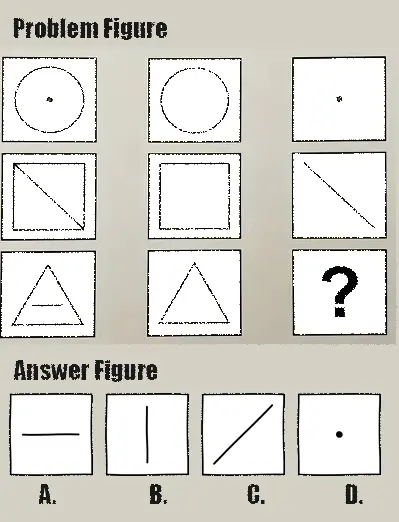
Select a suitable figure to replace the question mark (?) in the third row of the figure matrix.
Solution:
Rule: The 3rd figure in each row is obtained by removing the common element from the 1st figure and keeping the unique element.
- Row 1: Circle (common) is removed → Dot is kept.
- Row 2: Square (common) is removed → Diagonal line is kept.
- Row 3: Triangle (common) is removed → Horizontal line is kept.
Answer: A
8. Complex Multi-Step Patterns
These questions involve two or more operations or changing rules at each step, requiring careful analysis to determine the missing character.
Example: Find the missing number in the matrix:
| 28 | 10 | 10 | 180 |
| 29 | 17 | 11 | 132 |
| 35 | 15 | 12 | ? |
Solution:
Step 1: Identify the pattern using the known rows.
Row 1: (28 − 10) × 10 = 18 × 10 = 180 ✓
Row 2: (29 − 17) × 11 = 12 × 11 = 132 ✓
Rule: (First number − Second number) × Third number = Fourth number
Step 2: Apply the rule to Row 3.
(35 − 15)× 12 = 240
Answer: 240
How to Solve These Questions
Follow this step-by-step method during your exam.
Step 1: Observe the Arrangement Carefully
Identify what type of characters are used, how they’re arranged (rows, columns, or a geometric shape), and where exactly the missing element sits.
Step 2: Identify Potential Patterns
Start simple: check rows and columns, compare all the given figures, look for a repeated operation, and test a few common mathematical operations.
Step 3: Test the Pattern
Apply your suspected pattern to the known elements first — for a matrix, test row-wise before moving to column-wise — and confirm it holds consistently across every given value.
Step 4: Work Through Common Operations in Order
Try addition, subtraction, multiplication, division, squares, cubes, averages, differences, ratios, and products, roughly in that order of likelihood.
Step 5: Apply the Pattern to Find the Missing Element
Once the rule is confirmed, apply it directly to solve for the missing character.
Step 6: Verify Your Answer
Check that the pattern explains every visible element, not just the one you were solving for, and that it holds in both directions for a matrix (row-wise and column-wise).
Step 7: Manage Your Time
If a question is taking too long, mark it, move on, and return later if time allows: Solve → Mark if necessary → Move on → Return later.
Effective Tricks to Solve These Questions
👉 Trick 1: Start with Simple Operations
Check addition, subtraction, multiplication, and division before assuming the pattern is something more complicated.
👉 Trick 2: Think Both Row-Wise and Column-Wise
In matrix problems, always test horizontal patterns and vertical patterns separately — the rule might only be obvious in one direction.
👉 Trick 3: Use Alphabet Positions for Letter Series
Convert letters to numbers using A=1 through Z=26 before trying to spot a numerical pattern.
👉 Trick 4: Check for Common Mathematical Relationships
Sum, difference, product, division, squares, cubes, and prime numbers cover the vast majority of patterns — try these before anything more exotic.
👉 Trick 5: Look for Alternating Patterns
Some sequences alternate between two different operations from term to term, rather than applying a single consistent rule.
👉 Trick 6: Use the Elimination Technique
Test the answer options directly to rule out obviously wrong ones and narrow your search.
👉 Trick 7: Verify the Rule Across All Elements
A correct pattern must explain every visible element in the arrangement, not just the couple you used to spot it.
👉 Trick 8: Look for Hidden, Non-Obvious Patterns
The rule is rarely stated outright — expect to test a few operations before finding the one that fits consistently.
👉 Trick 9: Check Diagonal Relationships in Matrices
Beyond rows and columns, some matrix patterns run along the diagonals instead.
👉 Trick 10: Practice with a Variety of Figure Types
Work through circles, triangles, squares, stars, and unusual shapes so no single figure type catches you off guard.
Important Tips to Solve These Questions
Common Mistakes to Avoid
👉 Testing the pattern on only one row or column — always verify a suspected rule against every given row and column before trusting it
👉 Overlooking simple operations — jumping straight to complex multi-step patterns when a basic addition or multiplication would have worked
👉 Ignoring alphabet position logic — letter puzzles almost always reduce to a numeric pattern once converted
👉 Missing alternating patterns — assuming a single consistent rule when the sequence actually alternates between two operations
👉 Rushing past verification — a plausible-looking answer that only explains part of the arrangement is still wrong
Quick Solving Checklist
Before selecting your answer, use this checklist:
👉 Observed the arrangement carefully
👉 Identified the type of characters used (numbers, letters, or both)
👉 Checked rows and columns for patterns
👉 Tested basic mathematical operations
👉 Looked for square, cube, or prime number patterns
👉 Converted letters to alphabet positions where relevant
👉 Verified the pattern works for all given elements
👉 Applied the pattern to find the missing character
👉 Checked that the answer makes logical sense
👉 Avoided spending too much time on one question
Practice Questions
Conclusion
Mastering the Missing Character and Matrix Reasoning Test is essential for the Nepal Army Officer Cadet Entrance Examination. Success requires systematic observation and logical analysis — not guesswork — across scenarios involving numbers, letters, matrices, and geometric figures.
Follow this disciplined approach:
Observe → Identify Pattern → Test → Apply → Verify → Answer
Regular practice enhances pattern recognition, speed, logic, and accuracy. With the right approach and consistent practice, these questions can become some of the highest-scoring in the Numerical Reasoning section.
This resource is part of the Officer Cadet Entrance Exam Preparation series, focusing on IQ and Logical Reasoning for the Nepal Army Officer Cadet Entrance Exam. For structured lessons, comprehensive practice banks, and mock tests, explore the Missing Character and Matrix Reasoning Test subtopic under the Numerical Reasoning topic in the IQ and Logical Reasoning course on the Pratima Academy LMS.