
Embedded Figures and Dot Situation Test is an important part of IQ and Logical Reasoning that tests your ability to identify hidden figures within complex shapes and determine the position of dots in different regions.
For Officer Cadet Entrance Exam preparation, these questions help develop visual perception, attention to detail, mental rotation, pattern recognition, and analytical reasoning skills. Explore the complete Officer Cadet Exam resources and IQ for Officer Cadet preparation for additional practice and study materials.
- What are an Embedded Figures and Dot Situation Test?
- What Skills Do These Questions Measure?
- Important Terms and Definitions
- Fundamental Concepts: Embedded Figures
- Types of Embedded Figures and Dot Situation Questions
- 1. Simple Shape in a Complex Figure
- How to Solve Embedded Figures Questions
- How to Solve Dot Situation Questions
- Effective Tricks to These Questions
- Important Tips to These Questions
- Practice Questions
- Conclusion
- Related Resources
What are an Embedded Figures and Dot Situation Test?
This test combines two related but distinct non-verbal reasoning skills: detecting hidden figures and analyzing dot placements.
Embedded Figures Test
Embedded Figures Test questions require you to find a simple question figure hidden within one of the complex answer figures, possibly after rotation, reflection, or resizing. These questions test visual perception, spatial reasoning, and pattern recognition.
Example:
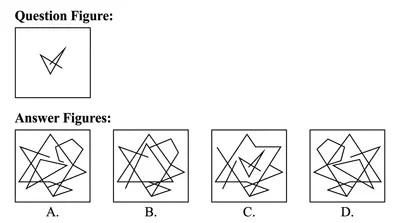
Find the figure in which the given question figure is embedded.
Solution:
The question figure’s most distinctive feature is its sharp acute spike pointing up-right.
A – no such spike
B – no narrow spike
C – spike present, plus the wide V and crossing line match exactly
D – spike points wrong way
Answer: C
Dot Situation Test
In a Dot Situation Test question, dots are placed within a figure containing overlapping shapes. You must identify the answer figure with the same relative positions and overlapping regions as the original.
Example:
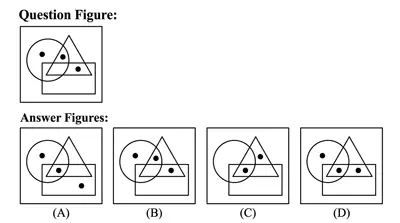
Select the answer figure that contains the same arrangement of dots as the question figure.
Solution:
👉 In the Question Figure:
👉 The first dot is inside the circle only.
👉 The second dot is inside both the circle and triangle.
👉 The third dot is inside both the triangle and rectangle.
👉 Option (B) preserves all three dot positions relative to the overlapping shapes.
Answer: B
What Skills Do These Questions Measure?
Embedded figures and dot situation questions test your ability in:
👉 Visual perception and spatial awareness – accurately reading complex diagrams
👉 Attention to detail – catching subtle matches and mismatches between figures
👉 Mental rotation and transformation – picturing a shape rotated or reflected
👉 Pattern recognition – identifying which features are meaningful and which are distractors
👉 Analytical reasoning – systematically narrowing down options rather than guessing
👉 Observation and comparison – comparing a small figure or region condition against several alternatives
👉 Speed and accuracy – solving visually dense problems within exam time limits
This combined topic is a high-scoring area in the Non-Verbal Reasoning section because questions follow predictable patterns and test fundamental cognitive abilities.
Important Terms and Definitions
👉 Embedded figure – a simple shape hidden or contained within a larger, more complex figure
👉 Question figure – the simple figure you need to find hidden within the answer figures
👉 Answer figure – the complex figures among which the question figure is embedded
👉 Mental rotation – the ability to mentally rotate a shape to view it from different angles
👉 Reflection/mirror image – the mirror image of a figure, where left and right are reversed
👉 Orientation – the direction or position a figure is placed in, whether upright, rotated, or flipped
👉 Dot situation – a question type where dots are placed in specific regions of a figure, and you must find an alternative with the same placement conditions
👉 Overlapping region – the area where two or more shapes intersect or share space
Fundamental Concepts: Embedded Figures
The question figure must be an actual, integral part of the answer figure — sharing lines, curves, and angles with it, not just resembling it superficially. It may be rotated at any angle, and it may also appear as a mirror image rather than in its original orientation. The embedded figure’s size may vary from the original as long as its proportions are maintained, and answer figures often include similar-looking shapes or extra lines specifically designed to distract you.
Fundamental Concepts: Dot Situation
Each dot sits in a specific region defined by how shapes like circles, triangles, and squares overlap. The correct alternative must allow every dot to be placed in a region with the exact same combination of shapes as the original figure. When multiple dots are involved, each one represents a separate region condition, and the alternative must satisfy all of them simultaneously. A region may be exclusive to a single shape (inside the circle but outside the triangle) or common to multiple shapes (inside both the circle and the triangle).
Types of Embedded Figures and Dot Situation Questions
Embedded Figures and Dot Situation Questions may involve: hidden shapes, rotated or mirrored figures, distractors, and dots in specific or overlapping regions.
1. Simple Shape in a Complex Figure
A basic shape is hidden within a larger or more complicated design, and you must identify where the given shape appears.
Example:
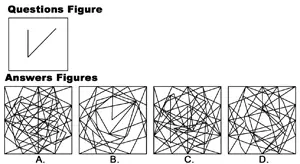
Find the figure in which the given question figure is embedded.
Solution:
Answer: C. It is the only figure that contains the exact open “V” shape in the correct orientation and with the correct proportions hidden within its design.
2. Rotated Figure
The required figure is present in the complex design but appears at a different angle or orientation.
Example:
Find the figure in which the given question figure is embedded.
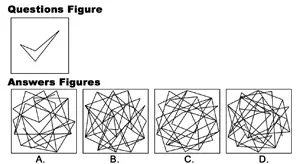
Solution:
Answer: A. It is the only figure that contains the exact open “checkmark” shape hidden within its design in the correct orientation.
3. Mirrored Figure
The required figure appears as a mirror image, with its orientation reversed while retaining the same basic structure.
Example:
Find the figure in which the given question figure is embedded.
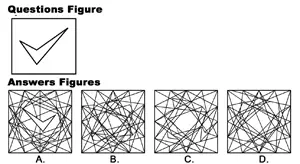
Solution:
Answer: A. The check-mark shape is clearly visible in the lower-left center of A, with the same left arm, bottom point and long right arm as in the question figure. B, C and D have no matching shape.
4. Figure with Distractors
Extra lines, curves, or shapes are added to the figure to make the required pattern harder to recognize.
Example:
Find the figure in which the given question figure is embedded.
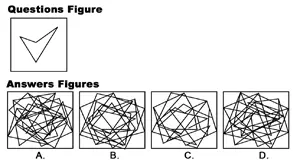
Solution:
Answer: C The whole shape fits inside the square, and its left arm, bottom point and long right arm all follow the actual lines.
A, B and D: The best fits all run off the bottom edge of the square, so the shape doesn’t fit.
5. Dot Situation with a Single Dot
A single dot is placed in a specific region, and you must find the option containing the same positional relationship among the surrounding shapes.
Example:
Select the answer figure that contains the same arrangement of dots as the question figure.
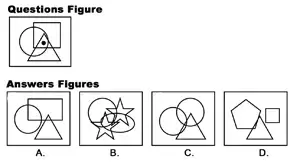
Solution:
Answer: B. The dot sits in the area shared by all three shapes, and only B has an area where three shapes overlap. In A and D the shapes are apart, and in C the triangle only touches the circles’ edges.
6. Dot Situation with Multiple Dots
Several dots are positioned in different regions, and you must identify the figure that reproduces all the required dot positions and relationships.
Example:
Select the answer figure that contains the same arrangement of dots as the question figure.
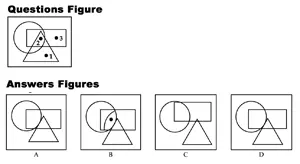
Solution:
Answer: B. It’s the only figure where the circle, rectangle and triangle all overlap in one shared area, which is where dot 2 sits in the question figure.
7. Complex Overlapping Regions
Multiple shapes overlap to create several regions, and you must determine the option in which the dots occupy the specified combinations of overlapping regions.
Example:
Select the answer figure that contains the same arrangement of dots as the question figure.
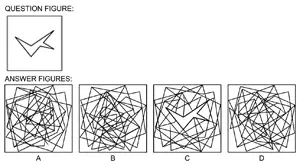
Solution:
Answer: C has all of these at the same size and orientation as the question figure, with no rotation or flipping. Figures A, B and D have no part that traces this outline.
How to Solve Embedded Figures Questions
Follow this step-by-step method during your exam.
Step 1: Analyze the Question Figure Carefully
Note its boundary shape, any sharp or unique angles, the lines and curves that make it up, and the relative proportions of its parts.
Step 2: Look for Unique Features
Search for the sharpest or most distinctive angle first, since rare shapes are the easiest to locate, and pay attention to unique junctions and end points that are hard to produce by chance.
Step 3: Eliminate Options
Rule out any option that doesn’t contain even a single matching angle, and use side-counting as a quick filter — a pentagon can never hide inside a quadrilateral.
Step 4: Use the Clockwise-Corner Rule
Label the corners of the question figure and look for that same sequence of corners, in the same order, within the answer figure.
Step 5: Check Rotations and Reflections
Mentally rotate the question figure through 90°, 180°, and 270°, and consider whether it might appear mirrored rather than simply rotated.
Step 6: Trace and Overlay
Trace the outline of the question figure with a finger or pencil and try to mentally overlay it onto each alternative.
Step 7: Ignore Irrelevant Lines
Focus only on matching the question figure’s actual features, and don’t let extra lines in the answer figure distract you.
Step 8: Verify
Once you find a likely match, confirm the question figure is genuinely an integral part of the answer figure rather than a coincidental resemblance.
How to Solve Dot Situation Questions
Follow this step-by-step method during your exam.
Step 1: Analyze the Given Figure (X)
Identify which shapes are present, where each dot sits, and exactly which region each dot occupies.
Step 2: Define Each Dot’s Region Condition
State each dot’s condition precisely — for example, “inside the circle but outside the triangle,” “inside both the circle and the triangle,” or “inside the triangle only.”
Step 3: Analyze Each Alternative Figure
For every alternative, identify the regions available and check whether a dot could be placed there to satisfy the same condition.
Step 4: Check All Dots
Confirm that every dot — not just one — can be placed in the alternative figure under the exact same region conditions as the original.
Step 5: Eliminate Incorrect Options
Rule out any alternative where a required region doesn’t exist, where a dot would fall into a different combination of shapes, or where a dot simply can’t be placed as specified.
Step 6: Verify
Confirm that your chosen alternative satisfies the placement conditions for all dots at once, not just the majority of them.
Effective Tricks to These Questions
Trick 1: Look for Unique Features First
👉The sharpest or most distinctive angle, junction, or end point in the question figure is usually the fastest thing to spot in the answer options.
Trick 2: Eliminate Using Angles
👉If the question figure has a specific angle, such as 90°, any option lacking that angle can be ruled out immediately.
Trick 3: Count Sides
👉A shape with more sides can never hide inside a shape with fewer sides — a pentagon can never be embedded in a quadrilateral, for instance.
Trick 4: Use the Clockwise-Corner Rule
👉Label the corners of the question figure and search for that same sequence of corners, in order, within the answer figure.
Trick 5: Check Rotations Systematically
👉Mentally rotate the question figure through 90°, 180°, and 270°, keeping in mind it may appear at any angle at all, not only these standard rotations.
Trick 6: Ignore Irrelevant Lines
👉Focus only on the features that match the question figure and don’t let extra lines in the answer figure distract you.
Trick 7: Trace the Outline Physically
👉Trace the question figure’s outline with a finger or pencil and try to overlay it directly onto each alternative.
Trick 8: Watch for Mirrored Versions
👉The question figure may appear reflected rather than simply rotated — always consider both possibilities.
Trick 9: Define Dot Regions Precisely
👉Be exact about each dot’s region — “inside circle only,” “inside circle and triangle,” or “inside triangle only” are meaningfully different conditions.
Trick 10: Check Every Dot, Not Just One
👉An alternative is only correct if all of its dots satisfy the same conditions as the original — a single mismatched dot rules the whole option out.
Important Tips to These Questions
Common Mistakes to Avoid
👉 Mistaking resemblance for embedding — a shape that merely looks similar isn’t the same as one that’s an actual integral part of the figure
👉 Forgetting rotation and reflection are both possible — checking only for rotation, or only for direct matches, misses valid answers
👉 Getting distracted by extra lines — answer figures are often cluttered on purpose; focus only on the features that matter
👉 Checking only one dot in multi-dot questions — every dot’s condition must hold simultaneously, not just the easiest one to verify
👉 Confusing “common to two shapes” with “exclusive to one shape” — these are different region conditions and easy to mix up under time pressure
Quick Solving Checklist
Before selecting your answer, use this checklist:
👉 Analyzed the question figure carefully
👉 Looked for unique angles, junctions, and end points
👉 Counted sides for quick elimination
👉 Considered rotations and reflections
👉 Eliminated options without matching features
👉 Traced the outline and overlaid it on the options
👉 Defined each dot’s region condition precisely (for dot situations)
👉 Verified the answer satisfies all conditions
👉 Avoided spending too much time on one question
Practice Questions
Conclusion
Mastering the Embedded Figures and Dot Situation Test is essential for the Nepal Army Officer Cadet Entrance Examination. Success requires systematic visual analysis, mental rotation, and precise region identification — not guesswork — across scenarios involving hidden shapes, overlapping regions, and complex figure arrangements.
Follow this disciplined approach:
Analyze → Identify Features → Eliminate → Verify → Answer
Regular practice enhances pattern recognition, visual perception, speed, and accuracy — skills that matter for officers who must quickly identify patterns, analyze complex situations, and make accurate decisions under pressure.
This resource is part of the Officer Cadet Entrance Exam Preparation series, focusing on IQ and Logical Reasoning for the Nepal Army Officer Cadet Entrance Exam. For structured lessons, comprehensive practice banks, and mock tests, explore the Embedded Figures and Dot Situation Test subtopic under the Non-Verbal Reasoning topic in the IQ and Logical Reasoning course on the Pratima Academy LMS.