
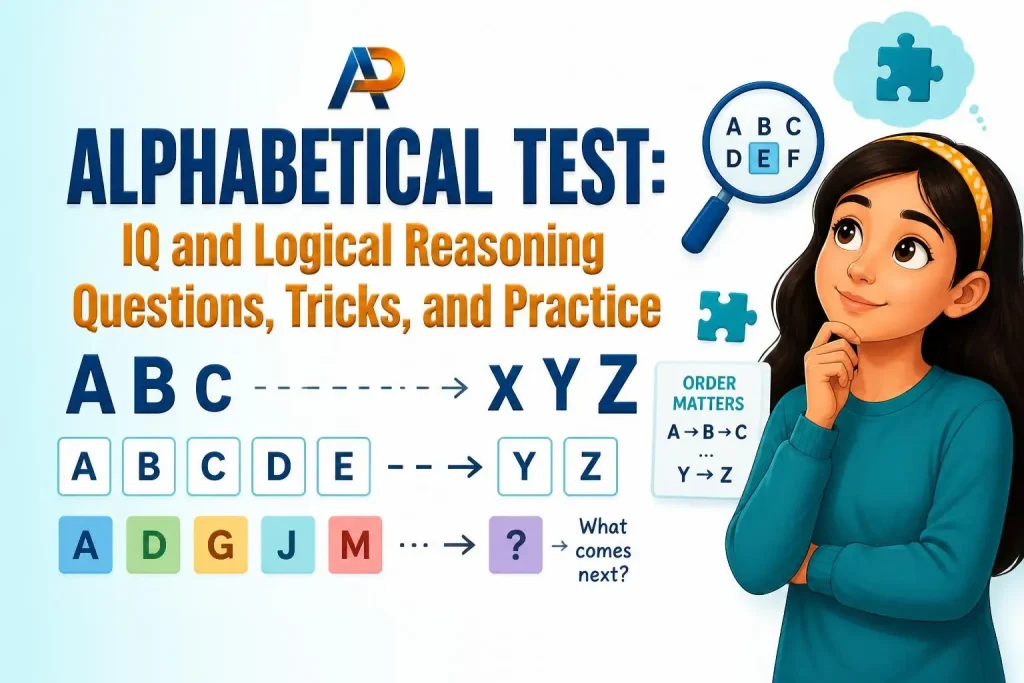
Alphabetical Test is an important part of IQ and Logical Reasoning that tests your understanding of the English alphabet and your ability to identify letter positions, patterns, and relationships.
For Officer Cadet Entrance Exam preparation, these questions help develop attention to detail, pattern recognition, logical thinking, and quick reasoning skills. Explore the complete Officer Cadet Exam resources and IQ for Officer Cadet preparation for additional practice and study materials.
What is an Alphabetical Test?
An alphabetical test measures your ability to work with the English alphabet — its order, the numeric position of each letter, and the patterns that can be formed using letters. Your task is to find a letter’s position, arrange items alphabetically, spot a pattern, or identify what breaks it.
Example: Arrange the following words in alphabetical order: Apple, Banana, Mango, Grapes Compare the first letters of each word: A, B, M, G. Answer: Apple, Banana, Grapes, Mango
What Skills Do These Questions Measure?
Alphabetical test questions assess several cognitive abilities:
- Knowledge of alphabet order – Recall where each letter sits
- Attention to detail – Spot small differences between letters or words
- Pattern recognition – Identify relationships between letters
- Logical sequencing – Deduce rules from given information
- Speed and accuracy – Work efficiently under time pressure
Types of Alphabetical Test Questions
1. Letter Position
Finding the position of a letter in the alphabet, counted from either end.
Alphabet Positions
A=1, B=2, C=3, D=4, E=5, F=6, G=7, H=8, I=9, J=10, K=11, L=12, M=13, N=14, O=15, P=16, Q=17, R=18, S=19, T=20, U=21, V=22, W=23, X=24, Y=25, Z=26
Example:
What is the position of J from the right end of the alphabet?
J is the 10th letter from the left.
Position from right = 27 − 10 = 17th
Answer: 17th
Reverse Alphabet Positions
For counting from the right end (Z=1, Y=2, … A=26):
Example:
Which letter is 5th from the right end of the alphabet?
26 − 5 + 1 = 22nd letter from the left.
Answer: V
Letters between = |Position1 − Position2| − 1
Example: How many letters are between M and T?
M is the 13th letter, T is the 20th letter. 20 − 13 − 1 = 6 letters (N, O, P, Q, R, S)
Answer: 6
2. Alphabetical Order
Arranging words or letters into alphabetical sequence.
Example:
Arrange the following words in alphabetical order:
Orange, Apple, Mango, Banana
Compare the first letters: A, B, M, O
Answer: Apple, Banana, Mango, Orange
3. Letter Series
Identifying the pattern in a sequence of letters and finding the missing or next one.
Example:
Find the next letter: A, C, E, G, ?
The pattern is +2 positions each time (skip one letter).
A → C → E → G → I
Answer: I
4. Letter Analogies
Finding the relationship between two letters and applying it to another pair.
Example:
A : C :: E : ?
A to C is +2 positions.
Apply the same to E: E + 2 = G
Answer: G
5. Letter Classification
Finding the odd letter out based on position, vowel/consonant status, or another shared property.
Example:
Find the odd one out: A, E, I, B, O
A, E, I, and O are all vowels.
B is a consonant.
Answer: B
6. Alphabetical Arrangement
Rearranging the letters of a word, or applying alphabetical order within a word or set.
Example:
Arrange the letters of the word “TEACHER” in alphabetical order.
Letters: T, E, A, C, H, E, R
Sorted: A, C, E, E, H, R, T
Answer: ACEEHRT
Example:
If the letters in “MANGO” are arranged alphabetically, which letter is in the middle?
Letters: M, A, N, G, O → alphabetical order: A, G, M, N, O.
The middle (3rd of 5) is M.
Answer: M
How to Solve Alphabetical Test Questions
Follow this step-by-step method during your exam.
Step 1: Know the Alphabet Positions
Memorize the position of all 26 letters so recall is instant, not counted from A each time.
Step 2: Know the Reverse Positions
Learn the positions counted from Z as well, for “from the right end” questions.
Step 3: Apply the Right-Position Formula
Use Position from the right = 26 − Position from the left + 1 instead of counting backward.
Step 4: Apply the Letters-Between Formula
Use Letters between = |Position1 − Position2| − 1 to avoid manually listing letters.
Step 5: Compare Words Letter by Letter
For ordering questions, compare letter by letter from left to right, and remember that a shorter prefix word comes before its longer extension.
Effective Tricks to Solve Alphabetical Test Questions
Trick 1: Memorize the Alphabet in Pairs
Break the alphabet into pairs to recall positions faster: A(1) B(2) | C(3) D(4) | E(5) F(6) | G(7) H(8) | I(9) J(10) | K(11) L(12) | M(13) N(14) | O(15) P(16) | Q(17) R(18) | S(19) T(20) | U(21) V(22) | W(23) X(24) | Y(25) Z(26)
Trick 2: Follow a Clear Ordering Rule
Compare first letters, then second letters, and so on, until you find a difference. A prefix word always comes first.
Trick 3: Remember Key Positions
Some positions are worth memorizing outright: 5th = E, 10th = J, 13th = M (the midpoint), 18th = R, 20th = T, 26th = Z.
Trick 4: Use the Right-Position Formula
Don’t count backward from Z each time — apply the formula directly.
Trick 5: Use the Difference Between Positions
For letter series and analogies, convert letters to numbers and find the numeric difference — this reveals the pattern immediately.
Trick 6: Learn Common Series Patterns
Watch for constant gaps (+1, +2, +3), increasing gaps (+2, +3, +4…), alternating patterns (+2, −1, +2, −1), and square-number gaps (A, D, I, P, Y → positions 1, 4, 9, 16, 25).
Important Tips to Solve Alphabetical Test Questions
Before selecting your answer, use the following checklist:
👉 Convert letters into their alphabetical positions when required.
👉 Use the correct formula for finding the position of a letter.
👉 Apply the letters-between formula when needed.
👉 Compare words letter by letter, especially when one word is a prefix of another.
👉 In classification questions, identify the common property or relationship among the items.
👉 In alphabet series, look for constant, increasing, decreasing, alternating, or square-number patterns.
👉 Check the identified pattern against all the given terms before choosing an answer.
👉 If a question seems difficult, do not spend too much time on it; move on and return to it later.
Practice Questions
Conclusion
Mastering the Alphabetical Test is essential for the Nepal Army Officer Cadet Entrance Examination. Success requires a strong, fast command of alphabet order, positions, and letter-based patterns — not guesswork.
Follow this disciplined approach:
Know the Positions → Identify the Pattern → Apply the Formula → Verify
Regular practice strengthens your pattern recognition, logical thinking, speed, and accuracy.
This resource is part of the IQ and Logical Reasoning preparation series for the Nepal Army Officer Cadet exam. For structured lessons, comprehensive practice banks, and mock tests, explore the Alphabetical Test course on the Pratima Academy LMS.
This resource is part of the Officer Cadet Entrance Exam Preparation series, focusing on IQ and Logical Reasoning for the Nepal Army Officer Cadet Entrance Exam. For structured lessons, comprehensive practice banks, and mock tests, explore the Alphabetical Test subtopic under the Verbal Reasoning topic in the IQ and Logical Reasoning course on the Pratima Academy LMS.