
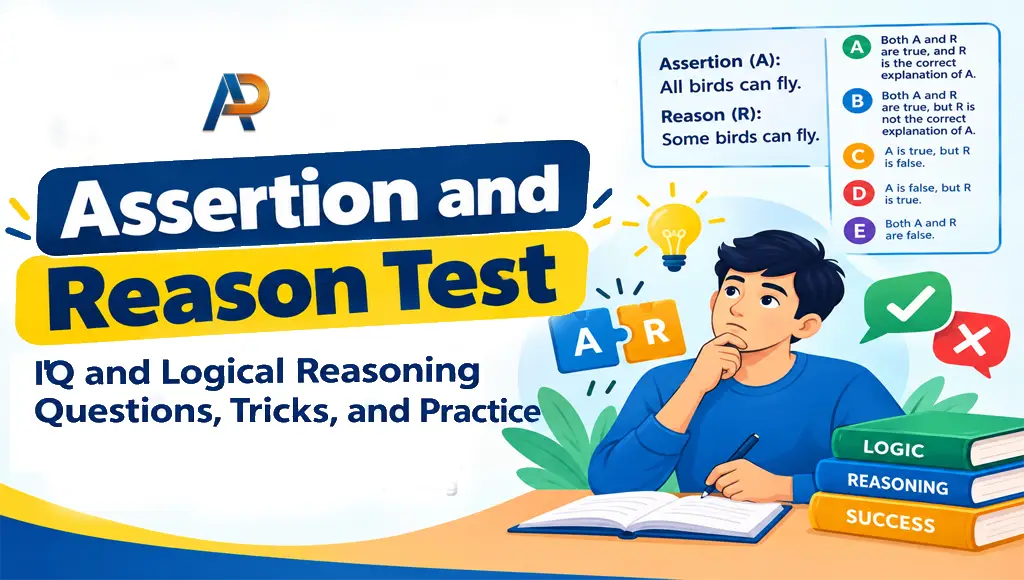
Assertion and Reason Test is an important part of IQ and Logical Reasoning that tests your ability to determine whether two related statements are true and whether one statement correctly explains the other.
For Officer Cadet Entrance Exam preparation, these questions help develop analytical thinking, cause-and-effect reasoning, logical judgement, and general awareness. Explore the complete Officer Cadet Exam resources and IQ for Officer Cadet preparation for additional practice and study materials.
- What is an Assertion and Reason Test?
- What Does an Assertion and Reason Test Measure?
- Preparation Strategy
- Types of Assertion and Reason Questions
- How to Solve Assertion and Reason Questions
- Effective Tricks to Solve Assertion and Reason Questions
- Important Tips to Solve Assertion and Reason Questions
- Practice Questions
- Conclusion
- Related Resources
What is an Assertion and Reason Test?
An Assertion and Reason Test presents two statements:
👉 Assertion (A): A claim or statement.
👉 Reason (R): A statement offered as an explanation for the Assertion.
Your task is to determine:
1. Whether each statement is true or false.
2. If both are true, whether R actually explains A.
The Five Answer Options
| Option | Meaning |
|---|---|
| 1 | Both A and R are true, and R is the correct explanation of A. |
| 2 | Both A and R are true, but R is not the correct explanation of A. |
| 3 | A is true, but R is false. |
| 4 | A is false, but R is true. |
| 5 | Both A and R are false. |
Understanding Each Option with Examples
Option 1 — Both true, R explains A
A: The sky appears blue.
R: Blue light is scattered more than other colors by the atmosphere.
Both statements are true, and Rayleigh scattering is exactly why the sky looks blue. R correctly explains A.
Answer: Option 1
Option 2 — Both true, but R does not explain A
A: Water boils at 100°C at sea level.
R: Water is made of hydrogen and oxygen atoms.
Both statements are true. However, the chemical composition of water does not explain its boiling point — atmospheric pressure does. R is true but irrelevant to A.
Answer: Option 2
Option 3 — A true, R false
A: All cats are animals.
R: All animals are cats.
A is true. R is false because many animals (dogs, birds, fish) are not cats.
Answer: Option 3
Option 4 — A false, R true
A: All birds can fly.
R: Birds have wings.
A is false (penguins, ostriches, and kiwis cannot fly). R is true — birds do have wings. Having wings does not guarantee flight.
Answer: Option 4
Option 5 — Both false
A: The moon is larger than the Earth.
R: The moon produces its own light.
Both statements are false. The moon is much smaller than the Earth, and it reflects sunlight rather than producing its own.
Answer: Option 5
What Does an Assertion and Reason Test Measure?
Assertion and reason questions test your ability in:
👉 Analytical thinking
👉 Understanding cause-and-effect relationships
👉 Evaluating the truth of individual statements
👉 Distinguishing “both true” from “one explains the other”
👉 Scientific and general knowledge
Preparation Strategy
👉 Judge the truth of A and the truth of R completely independently before comparing them.
👉 Once both are confirmed true, specifically test whether R is the cause of A, not merely a related true fact.
👉 Watch for absolute words like “all,” “never,” and “always” in either statement — they are often the reason a statement turns out false.
👉 Build a base of general scientific and everyday facts, since many assertions and reasons draw on common knowledge.
👉 Practice across scientific, logical, and cause-and-effect question types, not just one category.
Types of Assertion and Reason Questions
1. Scientific/General Knowledge
These questions are based on scientific facts or general knowledge.
Example
Assertion (A): Water boils at 100°C.
Reason (R): The boiling point of water depends on atmospheric pressure.
Analysis: Both A and R are true. R correctly explains why water boils at exactly 100°C — that figure holds specifically at standard atmospheric pressure, and changes at different pressures.
Answer: Both A and R are true, and R is the correct explanation of A.
2. Logical/Reasoning
These questions are based on logical relationships between categories or classes.
Example
Assertion (A): All cats are animals.
Reason (R): All animals are cats.
Analysis: A is true — every cat does belong to the category of animals. R is false, since the reverse relationship does not hold (dogs, birds, and fish are animals but not cats).
Answer: A is true, but R is false.
3. Cause and Effect
These questions involve a direct cause-and-effect relationship between two facts.
Example
Assertion (A): The roads are wet.
Reason (R): It rained last night.
Analysis: Both A and R are true, and rain overnight is a direct, sufficient cause of wet roads the next morning — R correctly explains A.
Answer: Both A and R are true, and R is the correct explanation of A.
How to Solve Assertion and Reason Questions
Use the following systematic method to solve assertion and reason questions quickly and accurately.
Step 1: Read Both Statements Carefully Read the Assertion (A) and the Reason (R) separately. Understand exactly what each one is claiming before comparing them.
Step 2: Determine the Truth of A Decide whether A is true or false, based on facts, logic, or general knowledge — judged entirely on its own.
Step 3: Determine the Truth of R Decide whether R is true or false, again judged entirely on its own, without letting A’s truth influence your judgment of R.
Step 4: Determine the Relationship Between A and R If both A and R are true, ask specifically:
👉 Does R logically lead to A?
👉 Is R the actual cause of A, or just another true fact that happens to sit nearby?
👉 Would A still be true even if R weren’t — meaning R isn’t really the reason?
Step 5: Select the Correct Option Based on your analysis of both truth values and the explanatory relationship, select the matching option from the five choices.
Effective Tricks to Solve Assertion and Reason Questions
Trick 1: Check Truth First, Explanation Second
👉 Always determine whether each statement is true or false as a separate step before you even consider whether one explains the other.
Trick 2: Ask “Does R Cause A?” Specifically
👉 If both statements are true, don’t assume R explains A just because they’re topically related — ask directly whether R is the actual cause or basis of A.
Trick 3: Be Careful with Absolute Words
👉 Statements using words like “all,” “never,” or “always” are often the ones that turn out to be false, since a single exception is enough to break them.
Trick 4: Use Common Sense and General Knowledge
👉 Many assertions and reasons rely on everyday scientific or general facts — apply what you already know rather than overanalyzing.
Trick 5: Eliminate Incorrect Options Systematically
👉 Once you’ve judged the truth of A and R, you can usually eliminate two or three of the five options immediately, leaving a much easier final choice.
Important Tips to Solve Assertion and Reason Questions
Tip 1: Practice Judging A and R Separately
The most common error is letting the truth of one statement bias your judgment of the other. Train yourself to cover one statement and judge the other in isolation first.
Tip 2: Practice Different Types
Do not practice only scientific questions. Include:
👉 Scientific/General Knowledge
👉 Logical/Reasoning
👉 Cause and Effect
Tip 3: Learn to Distinguish “Related” from “Explains”
Practice specifically on cases where both A and R are true but R is not the correct explanation (Option 2) — this is the trap most candidates fall into, since it’s easy to assume any true, related reason must be the right one.
Tip 4: Practice Against the Clock
Once you’re comfortable with the five-option format, practice under a time limit to build the same quick, careful judgment expected in a real exam.
Tip 5: Review Your Mistakes
Do not only check your final answer. Ask yourself:
👉 Did I let the truth of A influence how I judged R, or vice versa?
👉 Did I confuse “both true and related” with “both true and R explains A”?
👉 Did I miss an absolute word that made a statement false?
Understanding your mistakes strengthens the precise, two-step judgment this test is designed to measure.
Practice Questions
Conclusion
Mastering the Assertion and Reason Test is essential for the Nepal Army Officer Cadet Entrance Examination. Success requires the discipline to judge truth and explanation as two separate steps — not to assume that two true, related statements automatically explain each other. Follow a disciplined approach: Judge A → Judge R → Test the Explanation → Select the Matching Option. Regular practice — especially with cases where both statements are true but unrelated in cause — strengthens the precise analytical thinking every officer needs.
This resource is part of the Officer Cadet Entrance Exam Preparation series, focusing on IQ and Logical Reasoning for the Nepal Army Officer Cadet Entrance Exam. For structured lessons, comprehensive practice banks, and mock tests, explore the Assertion and Reason Test subtopic under the Verbal Reasoning topic in the IQ and Logical Reasoning course on the Pratima Academy LMS.