
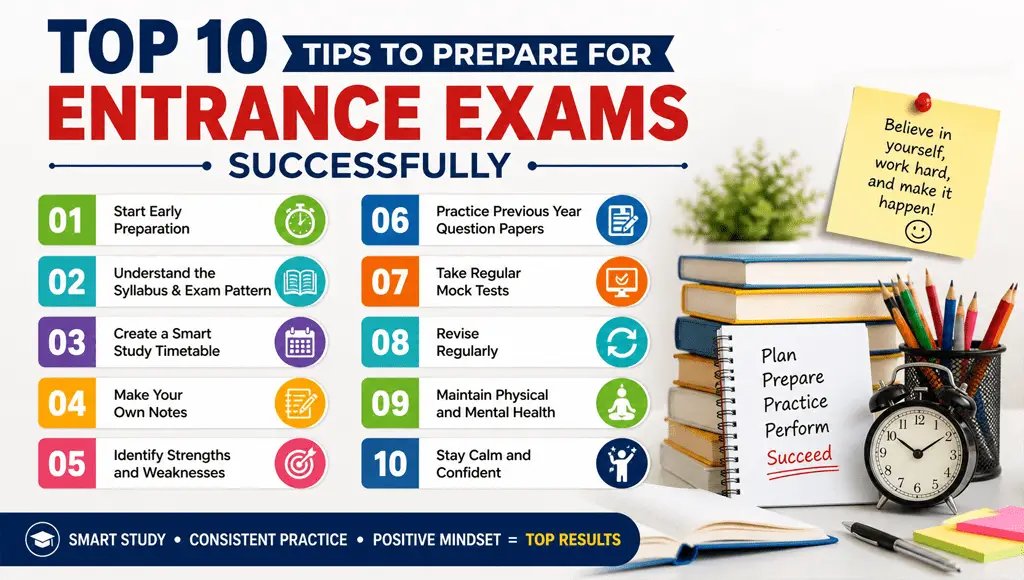
- Top 10 Tips to Prepare for Entrance Exams Successfully
- What is an Entrance Exam?
- Top 10 Tips to Prepare for Entrance Exams Successfully
- 1. Start Early
- 2. Know the Syllabus and Exam Pattern Inside Out
- 3. Build a Realistic Study Timetable
- 4. Make Your Own Notes
- 5. Know Your Strengths—and Be Honest About Your Weaknesses
- 6. Solve Previous Years' Question Papers
- 7. Take Regular Mock Tests
- 8. Revise on a Schedule, Not Just Before the Exam
- 9. Take Care of Your Physical and Mental Health
- 10. Walk In Calm and Confident
- Conclusion
Top 10 Tips to Prepare for Entrance Exams Successfully
Getting into a top-ranking school or academic institution is a dream for many students—and for their parents too. Entrance exams are highly competitive, testing not just subject knowledge but also aptitude, time management, and mental discipline.
At Pratima Academy, we’ve helped countless students turn preparation into performance. Our experience shows that success isn’t just about how many hours you study—it’s about how you study. This guide breaks down the ten most effective, field-tested strategies our mentors use to help students walk into their entrance exams prepared and confident.
What is an Entrance Exam?
An entrance exam is a standardized test used by schools, colleges, and institutions to identify students who are ready for the academic rigor of their programs. These exams typically assess reasoning ability, subject knowledge, and problem-solving speed—not just memorized facts.
At Pratima Academy, we train students to build all three: sharper knowledge, faster problem-solving, and stronger analytical thinking.
Top 10 Tips to Prepare for Entrance Exams Successfully
1. Start Early
The earlier you begin, the more room you have to learn, practice, and recover from mistakes. Early starters typically:
- Complete the full syllabus without last-minute rushing
- Get multiple rounds of practice instead of just one
- Walk into the exam with far less stress
A head start isn’t just about time—it’s about the confidence that comes with being genuinely ready.
2. Know the Syllabus and Exam Pattern Inside Out
You can’t prepare strategically for a test you don’t understand. Before diving into study material, get clear on:
- Which topics carry the most weight
- How marks are distributed (and where negative marking applies)
- The exam format—MCQs, descriptive, or a mix
At Pratima Academy, this is always our first step with new students, because it turns random studying into targeted preparation.
3. Build a Realistic Study Timetable
A timetable only works if you can actually follow it. Instead of cramming every subject into every day, try:
- Weighting time toward high-priority subjects and weak areas
- Blocking dedicated time for revision, not just new material
- Reviewing and adjusting the schedule weekly based on progress
Consistency beats intensity—a little every day adds up faster than marathon sessions.
4. Make Your Own Notes
Rewriting concepts in your own words does something rereading a textbook can’t—it forces your brain to actually process the information. Good notes:
- Improve long-term retention
- Turn into fast, effective revision material later
- Break down complex topics into simpler pieces you’ll actually remember
5. Know Your Strengths—and Be Honest About Your Weaknesses
Self-awareness is a preparation strategy in itself. Regularly ask: what am I confident in, and what still trips me up?
- Spend extra time reinforcing weak topics before they become a liability
- Keep strong subjects sharp with periodic practice
- Track progress weekly so you’re not guessing on exam day
6. Solve Previous Years’ Question Papers
Past papers are one of the highest-value resources available to any student. They reveal:
- Recurring question patterns and frequently tested topics
- How to manage time under real exam conditions
- Where the exam tends to trip students up
Aim to solve these under timed conditions, not just casually—it’s the closest thing to a dry run.
7. Take Regular Mock Tests
Mock tests are where preparation meets pressure. At Pratima Academy, they’re a core part of our program because they help students:
- Get an honest read on where they actually stand
- Build speed and accuracy simultaneously
- Get comfortable with exam-day pressure before the real thing
8. Revise on a Schedule, Not Just Before the Exam
Revision isn’t a last-minute activity—it’s what keeps earlier learning from fading. Make it a habit to:
- Revisit topics on a daily and weekly cycle
- Keep a running list of key formulas and core concepts
- Refresh older material regularly so it doesn’t get pushed out by newer topics
9. Take Care of Your Physical and Mental Health
No amount of studying compensates for a tired, foggy mind. Performance depends on:
- Consistent, quality sleep—especially in the final week
- Regular meals and proper hydration
- Short breaks, light activity, or anything that helps you decompress
10. Walk In Calm and Confident
By exam day, your preparation is largely done—the goal now is to not sabotage it. Students who perform best tend to:
- Skip last-minute cramming, which usually creates more anxiety than benefit
- Focus on the next question in front of them, not the ones behind
- Trust the work they’ve already put in
Conclusion
At Pratima Academy, we believe every student has the potential to succeed—what makes the difference is the right guidance, structure, and strategy. By applying these ten tips consistently, students can prepare more effectively, manage stress better, and perform at their best when it counts.
If you’re ready to turn this advice into results, explore our entrance exam courses designed around real exam patterns, practice with our previous years’ question papers, and test your readiness with mock exams on our learning platform. Every resource is built to help you prepare with purpose and walk into your exam with confidence.
Because success in entrance exams was never just about studying hard. It’s about studying smart—and having the right support along the way.