
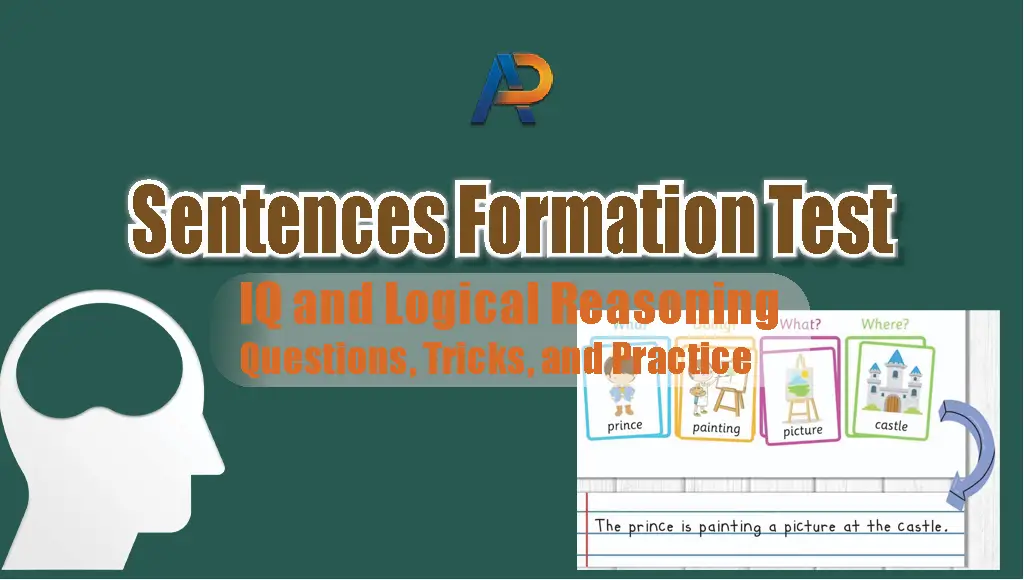
Sentence Formation Test is an important part of IQ and Logical Reasoning that tests your ability to arrange words, phrases, or sentences in a logical, grammatically correct, and meaningful order.
For Officer Cadet Entrance Exam preparation, these questions help develop language skills, logical thinking, grammar, comprehension, and the ability to organise ideas clearly. Explore the complete Officer Cadet Exam resources and IQ for Officer Cadet preparation for additional practice and study materials.
- What is a Sentences Formation Test?
- What Does a Sentences Formation Test Measure?
- Preparation Strategy
- Types of Sentences Formation Questions
- How to Solve Sentences Formation Questions
- Effective Tricks to Solve Sentences Formation Questions
- Important Tips to Solve Sentences Formation Questions
- Practice Questions
- Conclusion
- Related Resources
What is a Sentences Formation Test?
A Sentences Formation Test presents you with a set of jumbled words, phrases, or sentences. Your task is to rearrange them to form a coherent, grammatically correct sentence or paragraph.
Basic Pattern
You are given a set of words like: playing / children / are / the / in / park / the
Your task is to rearrange them into a meaningful sentence:
The children are playing in the park.
Example
Question: Arrange the following words to form a meaningful sentence:
home / I / go / to / every / day
Analysis: The subject is “I,” the verb is “go,” and the remaining words form a prepositional phrase (“home”) and a time expression (“every day”).
Answer: I go home every day.
What Does a Sentences Formation Test Measure?
Sentences formation questions test your ability in:
👉 Understanding of grammar and syntax
👉 Logical sequencing of ideas
👉 Vocabulary and word usage
👉 Attention to detail
👉 Speed and accuracy
Preparation Strategy
To improve your performance:
👉 Identify the subject, verb, and object first.
👉 Look for articles (a, an, the) and conjunctions.
👉 Identify clauses that are dependent or independent.
👉 Pay attention to punctuation clues like commas, periods, and question marks.
👉 Practice with a wide variety of sentence structures.
Types of Sentences Formation Questions
Sentence formation is an important part of Verbal Reasoning and English Language tests. It evaluates your ability to arrange words, phrases, or sentences in a logical, meaningful, and grammatically correct order.
Sentence formation questions can generally be divided into four major types:
1. Jumbled Words (Simple Sentences)
This is the most basic type. You are given a set of individual words and must arrange them into a single, correct sentence.
Example:
Question: Arrange the following words to form a meaningful sentence:
because / was / the match / postponed / it / raining / heavily / was
Analysis:
👉 Main subject: the match
👉 Main verb: was postponed
👉 Reason clause: because it was raining heavily
Answer: The match was postponed because it was raining heavily.
2. Jumbled Phrases (Complex/Compound Sentences)
This type involves rearranging larger groups of words (phrases or clauses) to form a grammatically correct complex or compound sentence.
Example
Question: Arrange the following phrases to form a meaningful sentence:
although / he was very tired / he continued working / until late at night
Analysis: This is a complex sentence with a dependent clause (“although he was very tired”) and an independent clause (“he continued working until late at night”). The dependent clause shows contrast and can be placed before or after the main clause.
Answer: Although he was very tired, he continued working until late at night.
3. Sentence Completion (Fill in the Blanks)
These questions present a sentence with a missing word or phrase. You must choose the option that completes the sentence meaningfully and grammatically.
Example
Question: Neither the teacher nor the students ______ aware of the change in the examination schedule.
Options: A) was B) were C) is D) has
Analysis: With “neither…nor,” the verb generally agrees with the subject closer to it. Since “students” is plural and is closest to the verb, the plural verb “were” is required.
Answer: B) were
4. Paragraph Formation (Jumbled Sentences)
This is the most advanced type. You are given a set of sentences that are out of order. Your task is to arrange them into a logical, coherent paragraph.
Example
Question: Arrange the following sentences to form a meaningful paragraph:
1. As a result, many students now use digital resources for research and study.
2. The rapid development of technology has transformed the way students learn.
3. Online libraries, educational websites, and digital databases provide access to a vast amount of information.
4. These resources allow students to find information quickly without depending entirely on printed books.
Analysis:
👉 Sentence 2 introduces the main topic: the impact of technology on learning.
👉 Sentence 3 explains how digital resources support students.
👉 Sentence 4 refers to “these resources,” so it logically follows Sentence 3.
👉 Sentence 1 gives the result of using these resources and concludes the paragraph.
Answer: 2 → 3 → 4 → 1
How to Solve Sentences Formation Questions
Use the following systematic method to solve sentences formation questions quickly and accurately.
Step 1: Identify the Subject The subject is the person, place, or thing the sentence is about — usually a noun or pronoun. Identifying it first helps you structure the rest of the sentence.
Step 2: Identify the Verb The verb is the action or state-of-being word. Every sentence needs a subject and a verb, so locating the verb tells you what the subject is doing.
Step 3: Look for Articles and Determiners Words like a, an, the, my, your, this, that usually come directly before a noun — for example, “the book,” not “book the.”
Step 4: Look for Prepositions and Their Objects Prepositions (in, on, at, to, with) are followed by a noun or pronoun to form a prepositional phrase, such as “in the park” or “to the store.”
Step 5: Identify Conjunctions Conjunctions like and, but, or, because, although connect clauses or words and reveal how the ideas in the sentence relate to each other.
Step 6: Check the Flow Once you have a possible order, read the sentence in your head to see if it sounds natural. If it feels awkward, adjust the order and try again.
Step 7: Verify Grammar Check for subject-verb agreement, correct tense, and proper article usage before finalizing your answer.
Effective Tricks to Solve Sentences Formation Questions
Trick 1: Find the Subject and Verb First
👉 This is the foundation of any sentence. Once you find the subject and verb, the remaining words usually fall into place around them.
Trick 2: Look for Articles (A, An, The)
👉 Articles are always followed by a noun, which helps you anchor nouns to the right position.
Trick 3: Watch for Prepositions
👉 Prepositions are followed by a noun and typically form a phrase that sits at the end of a clause or sentence.
Trick 4: Use Conjunctions to Understand Relationships
👉 Words like because and although introduce a reason or a contrast and often signal the start of a dependent clause. Words like and and but connect or contrast similar ideas.
Trick 5: Check Punctuation Clues
👉 A comma often separates a dependent clause from an independent clause; a period or question mark marks the end of the full sentence.
Trick 6: Read the Sentence Aloud (in Your Head)
👉 After arranging the words, read the sentence mentally. If it sounds grammatically correct and natural, it is very likely the right order.
Trick 7: Eliminate Impossible Options
👉 In multiple-choice sentence completion questions, try each option in the blank and eliminate any that break grammatical rules like subject-verb agreement or tense consistency.
Important Tips to Solve Sentences Formation Questions
Tip 1: Strengthen Your Grammar Fundamentals
A solid grasp of parts of speech, tenses, and subject-verb agreement makes every question type in this test faster to solve.
Tip 2: Practice Different Types
Do not practice only jumbled words. Include:
👉 Jumbled Words (Simple Sentences)
👉 Jumbled Phrases (Complex/Compound Sentences)
👉 Sentence Completion
👉 Paragraph Formation
Tip 3: Focus on Accuracy
A fast answer is only useful if the final sentence is fully correct. Build the habit of re-reading your arranged sentence before moving on.
Tip 4: Practice Against the Clock
Once you’re comfortable with the method, solve sentence formation questions under a time limit to build both speed and accuracy.
Tip 5: Review Your Mistakes
Do not only check your final score. Ask yourself:
👉 Did I misidentify the subject or verb?
👉 Did I misplace an article or preposition?
👉 Did I ignore a punctuation or conjunction clue?
👉 In paragraph formation, did I pick the wrong opening sentence?
Understanding your mistakes strengthens your grammar and logical sequencing over time.
Practice Questions
Conclusion
Mastering the Sentences Formation Test is essential for the Nepal Army Officer Cadet Entrance Examination. Success requires a strong command of grammar, syntax, and logical sequencing — not guesswork. Follow a disciplined approach: Identify the Subject and Verb → Look for Articles and Prepositions → Check the Flow → Verify the Grammar. Regular practice strengthens your language skills, logical thinking, speed, and accuracy.
This resource is part of the Officer Cadet Entrance Exam Preparation series, focusing on IQ and Logical Reasoning for the Nepal Army Officer Cadet Entrance Exam. For structured lessons, comprehensive practice banks, and mock tests, explore the Sentences Formation Test course on the Pratima Academy LMS.