
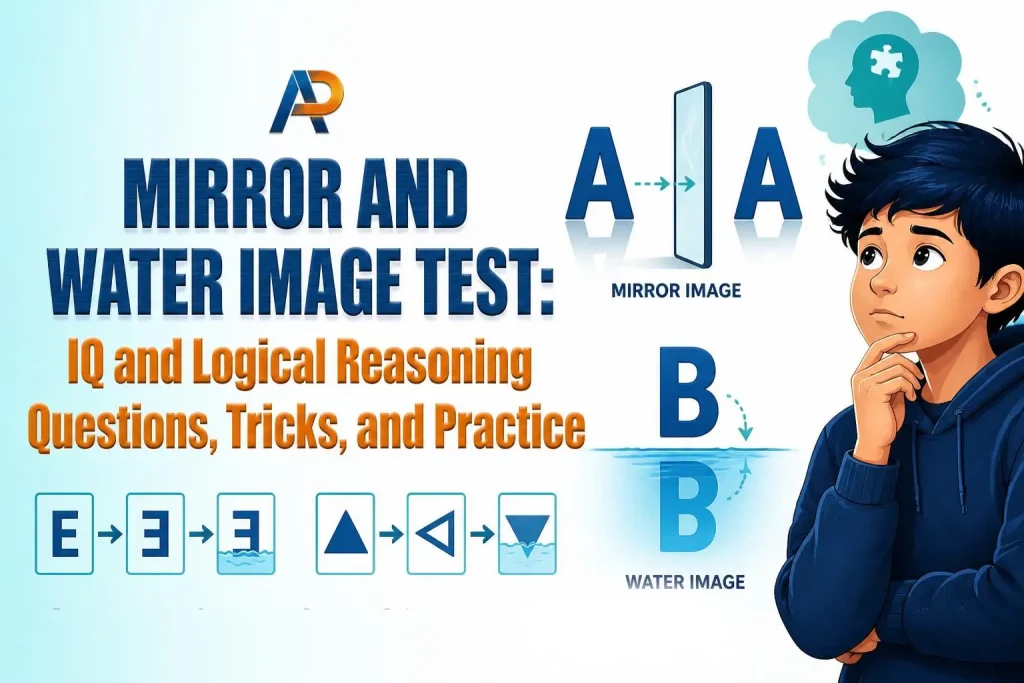
Mirror and Water Image Test is an important part of IQ and Logical Reasoning that tests your ability to visualize how objects, letters, numbers, and figures appear when reflected in a mirror or on a water surface.
For Officer Cadet Entrance Exam preparation, these questions help develop spatial visualization, visual perception, attention to detail, and reasoning skills. Explore the complete Officer Cadet Exam resources and IQ for Officer Cadet preparation for additional practice and study materials.
- What are Mirror and Water Images?
- Where This Fits in Non-Verbal Reasoning
- What Skills Do These Questions Measure?
- Types of Mirror and Water Image Test
- 1. Mirror Images of Letters and Numbers
- 2. Mirror Images of Words
- 3. Mirror Images of Figures and Shapes
- 4. Water Images of Letters and Numbers
- 5. Water Image of Words
- 6. Water Images of Figures and Shapes
- How to Solve Mirror and Water Image Questions
- Effective Tricks to Solve Mirror and Water Image Questions
- Important Tips to Solve Mirror and Water Image Questions
- Practice Questions
- Conclusion
- Related Resources
What are Mirror and Water Images?
Mirror Image
A mirror image is the reflection of an object as seen in a mirror. The image is laterally inverted, meaning the left and right sides are reversed while the top and bottom stay the same.
Question:
When the mirror is held at XY, which of the following answer figures represents the exact mirror image of the given question figure?
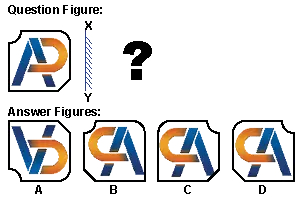
Solution:
In a vertical mirror reflection (mirror held at line XY), the left and right sides swap, but the top and bottom remain unchanged.
👉 Position: The blue ‘A’ (originally on the left) and orange ‘P’ (originally on the right) will swap, so the ‘A’ remains on the left and the ‘P’ on the right.
👉 Boundary: The notch on the top-left corner must remain on the top-left.
👉 Shape: The internal shapes of the letters must be accurately reflected without distortion.
Evaluating the options:
👉 Figure A: Incorrectly inverted.
👉 Figure B: Notch is on the wrong side (top-right).
👉 Figure C: Distorts the letter shapes (slanted stems).
👉 Figure D: Correctly mirrors the letters and keeps the notch in the correct position.
Answer: D
Water Image
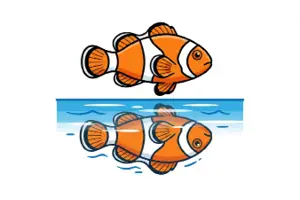
A water image is the reflection of an object as seen in water. The image is vertically inverted, meaning the top and bottom sides are reversed while the left and right stay the same.
Question:
When the water is placed along line XY, which of the following answer figures represents the exact water image of the given question figure?

Solution:
In a water image, the top and bottom are interchanged while the left and right remain the same.
👉 The square (top-left) and triangle (top-right) move to the bottom-left and bottom-right, respectively.
👉 The octagon (bottom-left) and circle (bottom-right) move to the top-left and top-right, respectively.
👉 The diagonal line, originally running from top-right to bottom-left, will flip to run from top-left to bottom-right.
👉 Figure B correctly reflects all these elements and the diagonal line.
Answer: B
Where This Fits in Non-Verbal Reasoning
Non-verbal reasoning is the branch of reasoning that uses visual and spatial information — shapes, figures, and diagrams — rather than words or numbers. It measures how well you can perceive, manipulate, and draw logical conclusions from images alone, which makes it a natural fit for testing an officer’s ability to read maps, terrain sketches, and visual signals under pressure.
The Mirror and Water Image Test sits alongside other common non-verbal reasoning topics such as:
👉 Series completion – identifying the next figure in a visual sequence
👉 Classification – grouping figures that share a common property
👉 Analogy – matching a figure-pair relationship to another pair
👉 Paper folding and cutting – visualizing the result of folds and cuts
👉 Embedded figures – spotting a shape hidden within a larger figure
👉 Pattern completion – filling in a missing piece of a figure
What sets mirror and water image questions apart from the rest of this group is that they test a very specific transformation — reflection — rather than sequence, grouping, or hidden-shape recognition. Mastering the rules of lateral and vertical inversion here also strengthens your spatial visualization for the other non-verbal reasoning topics above.
What Skills Do These Questions Measure?
Mirror and water image questions test your ability in:
👉 Spatial visualization and orientation – mentally rotating and flipping objects
👉 Attention to detail – catching small differences between an object and its reflection
👉 Understanding of lateral and vertical inversion – knowing which axis flips and which doesn’t
👉 Logical reasoning – applying a consistent rule across letters, numbers, or figures
👉 Speed and accuracy – solving reflection problems quickly under exam time pressure
Types of Mirror and Water Image Test
Mirror and water image test may involve:
1. Mirror Images of Letters and Numbers
These questions test how individual letters and numbers appear when viewed in a mirror. The image is reversed left to right, while the top and bottom remain unchanged.
Lateral Inversion
A mirror image is laterally inverted:
👉 The left side of the object becomes the right side in the image
👉 The right side of the object becomes the left side in the image
👉 The top and bottom remain the same
Example:
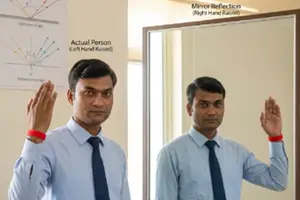
If you stand in front of a mirror, your left hand appears as your right hand in the reflection, and your right hand appears as your left hand.
1.1 Mirror Image of Letters
Some letters remain the same in a mirror because they’re symmetrical along the vertical axis, while others change completely.
👉 Unchanged (symmetrical) letters: A, B, C, D, E, H, I, M, O, T, U, V, W, X, Y, S, Z
👉 Changed letters: P becomes a reversed “q”-like shape, Q becomes a reversed “b”-like shape, and R becomes a reversed, mirrored “Я”-like shape

1.2 Mirror Image of Numbers
Most digits are close enough to vertically symmetrical that they appear unchanged in a mirror, though the exact rendering depends on the font.
👉 0, 1, 2, 3, 4, 5, 6, 7, 8, 9 typically appear as themselves, reversed in position but not in shape, when the font is symmetrical

2. Mirror Images of Words
These questions require identifying the mirror image of a complete word or group of letters. The order and appearance of the characters are reversed horizontally.
When you see a word in a mirror, the order of the letters is reversed, and each individual letter is also laterally inverted.
Example:
The word “CAT” becomes “TAC” in a mirror, with the letters reordered and each one flipped.
3. Mirror Images of Figures and Shapes
These questions involve geometrical figures, symbols, diagrams, or patterns. You need to determine how the entire figure would look when reflected in a mirror.
Question:
When the mirror is held at XY, which of the following answer figures represents the exact mirror image of the given question figure?
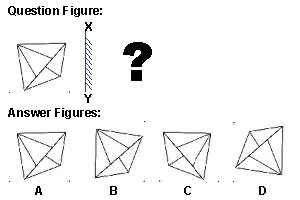
Answer: D
4. Water Images of Letters and Numbers
These questions test how individual letters and numbers appear when reflected in water. The image is reversed top to bottom, while the left and right sides remain unchanged.
Vertical Inversion
A water image is vertically inverted:
👉 The top of the object becomes the bottom in the image
👉 The bottom of the object becomes the top in the image
👉 The left and right sides remain the same
4.1 Water Image of Letters
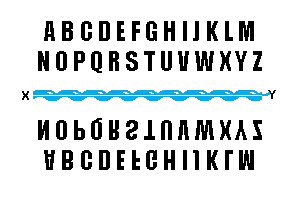
Some letters remain unchanged in water because they’re symmetrical along the horizontal axis, while others change.
👉 Unchanged (symmetrical) letters: A, B, C, D, E, H, I, M, O, T, U, V, W, X, Y, Q, R, S, Z
👉 Changed letters: P becomes a “b”-like shape under vertical inversion
4.2 Water Image of Numbers
👉 0, 1, 2, 3, 4, 5, 6, 7, 8, 9 typically appear as themselves when the font is vertically symmetrical, flipped in position but not in shape

5. Water Image of Words
These questions ask you to identify the water image of a word or group of letters. The complete word is reflected vertically, producing an upside-down appearance.
Question:
When the water is placed along line XY, which of the following answer figures represents the exact water image of the given question figure?

Answer: A
6. Water Images of Figures and Shapes
These questions involve figures, shapes, symbols, or diagrams reflected in water. The task is to identify the figure after its top and bottom have been reversed.
Question:
When the water is placed along line XY, which of the following answer figures represents the exact water image of the given question figure?
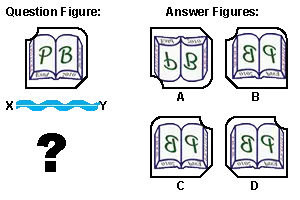
Answer: B
How to Solve Mirror and Water Image Questions
Use the following systematic method to solve mirror and water image questions quickly and accurately.
Step 1: Identify the Type of Image
Determine whether the question asks for a mirror image (lateral inversion) or a water image (vertical inversion) — this decision drives every step that follows.
Step 2: Visualize the Inversion
For a mirror image, imagine flipping the object left-to-right. For a water image, imagine flipping it top-to-bottom.
Step 3: Apply the Inversion to Each Element
For mirror images, reverse the order of the characters and invert each one laterally. For water images, invert each character vertically while keeping the order the same.
Step 4: Draw the Image if Necessary
If you’re unsure, sketch the object and its reflection on paper — this makes the transformation concrete rather than something you have to hold in your head.
Step 5: Check Your Answer
Compare your resulting image to the given options and confirm the transformation was applied correctly and consistently.
Effective Tricks to Solve Mirror and Water Image Questions
Trick 1: Understand the Difference
👉 Mirror images flip left and right while the top stays the top; water images flip top and bottom while the left stays the left.
Trick 2: Use Symmetry
👉 If a letter or number is symmetrical along the relevant axis, its mirror or water image will look the same — this shortcut eliminates a lot of unnecessary work.
Trick 3: Practice Visualization
👉 The more you practice, the faster and more accurately you’ll be able to picture reflections in your mind instead of relying on paper every time.
Trick 4: Draw the Object
👉 For complex figures or full words, draw the object and then draw its reflection step by step — it’s slower but far more reliable than guessing.
Trick 5: Check the Order
👉 For mirror images of words, the letter order reverses. For water images of words, the letter order stays the same — only orientation changes.
Trick 6: Be Careful with Fonts
👉 Some letters and numbers look different across fonts. Practice with the standard font style used in your exam materials.
Trick 7: Use the Process of Elimination
👉 When unsure, eliminate options with an obviously wrong inversion axis or letter order before choosing between what’s left.
Important Tips to Solve Mirror and Water Image Questions
Common Mistakes to Avoid
👉 Confusing mirror and water images — mixing up which axis flips leads to consistently wrong answers; always identify the image type first
👉 Forgetting to reverse letter order in mirror images — the order matters for mirrors but not for water
👉 Assuming all letters are symmetrical — some, like P, Q, and R, genuinely change shape
👉 Rushing without visualizing — skipping the mental (or paper) flip step increases careless errors
👉 Ignoring font differences — the same letter can invert differently depending on how it’s drawn
Quick Solving Checklist
Before selecting your answer, use this checklist:
👉 Identified whether the question asks for a mirror or water image
👉 Determined the correct axis of inversion (lateral or vertical)
👉 Reversed the letter order for mirror images, kept it for water images
👉 Applied the inversion consistently to every character or part of the figure
👉 Sketched the reflection on paper if the figure was complex
👉 Compared the result carefully against each option
👉 Avoided spending too much time on one question
Practice Questions
Conclusion
Mastering the Mirror and Water Image Test is essential for the Nepal Army Officer Cadet Entrance Examination. Success requires a strong understanding of lateral and vertical inversion and the ability to visualize spatial transformations — not guesswork.
Follow this disciplined approach:
Identify the Type of Image → Visualize the Inversion → Apply the Inversion → Verify
This topic is one of the more visual, hands-on parts of the non-verbal reasoning syllabus, and regular practice strengthens your spatial intelligence, visualization skills, speed, and accuracy — benefits that carry over to the other non-verbal reasoning topics you’ll face in the exam.
This resource is part of the Officer Cadet Entrance Exam Preparation series, focusing on IQ and Logical Reasoning for the Nepal Army Officer Cadet Entrance Exam. For structured lessons, comprehensive practice banks, and mock tests, explore the Mirror and Water Image Test course on the Pratima Academy LMS.