
Height and Distance Test is an important part of IQ and Logical Reasoning that tests your ability to apply trigonometric concepts to problems involving vertical heights and horizontal distances.
For Officer Cadet Entrance Exam preparation, these questions help develop visualization, trigonometric reasoning, numerical ability, and problem-solving skills. Explore the complete Officer Cadet Exam resources and IQ for Officer Cadet preparation for additional practice and study materials.
- What is Height and Distance Test?
- What Skills Do These Questions Measure?
- Important Terms and Definitions
- Types of Height and Distance Questions
- How to Solve Height and Distance Questions
- Effective Tricks to Solve Height and Distance Questions
- Important Tips to Solve Height and Distance Questions
- Practice Questions
- Conclusion
- Related Resources
What is Height and Distance Test?
Height and Distance Test is a type of trigonometry problem that involves finding the height of an object or the distance between two points using angles of elevation and depression.
In these questions, you are usually given an angle and one known side of a right-angled triangle. You then use sin, cos, or tan to find the unknown height or distance.
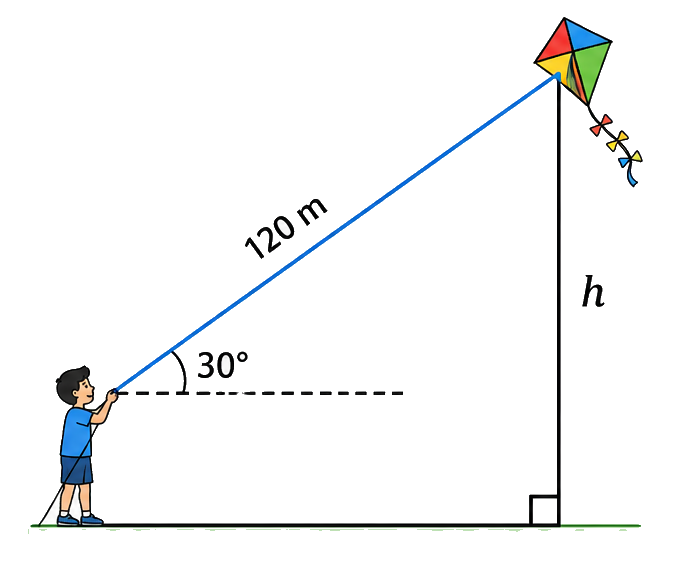
Example: A boy flies a kite using a 120 m long thread. The angle of elevation is 30°. Find the height of the kite.
Here, the thread is the hypotenuse and the kite’s height is the opposite side. Using the appropriate trigonometric ratio, the height is 60 m.
Height and Distance questions are often based on real-life situations, such as finding the height of a tower, building, tree, or pole, the length of a shadow, or the distance involving kites, aeroplanes, ships, lighthouses, and cliffs.
What Skills Do These Questions Measure?
Height and distance questions test your ability in:
👉 Visualization skills – converting a word problem into an accurate diagram
👉 Understanding of trigonometric ratios – applying sin, cos, and tan correctly
👉 Logical sequencing of given data – identifying what’s known and what’s missing
👉 Problem-solving speed and accuracy – setting up and solving the right equation quickly
Height and Distance is a high-scoring topic in the Numerical Reasoning section because questions are often straightforward and follow predictable patterns. Common scenarios include towers and buildings, shadows cast by the sun, kites and aeroplanes, ships and lighthouses, poles and trees (including broken ones), and rivers and cliffs measured from two points.
Important Terms and Definitions
👉 Height – the measurement of an object in the vertical direction
👉 Distance – the measurement from a particular point in the horizontal direction
👉 Angle of elevation – the angle between the horizontal line and the line of sight from an observer looking up at an object above them; for example, the angle between your horizontal line of sight and the top of a tower
👉 Angle of depression – the angle between the horizontal line and an observer’s line of sight to an object below them; for example, the angle from the top of a lighthouse down to a ship at sea
Important note: By the law of alternate angles, the angle of elevation and the angle of depression are equal in magnitude when the lines of sight are parallel.
Fundamental Formulas
Height and Distance problems are based on right-angled triangle trigonometry.
Basic Trigonometric Ratios
In a right-angled triangle:
👉 Sine (sin θ) = Opposite / Hypotenuse
👉 Cosine (cos θ) = Adjacent / Hypotenuse
👉 Tangent (tan θ) = Opposite / Adjacent
Standard Trigonometric Values
| Angle (θ) | sin θ | cos θ | tan θ |
|---|---|---|---|
| 0° | 0 | 1 | 0 |
| 30° | 1/2 | √3/2 | 1/√3 |
| 45° | 1/√2 | 1/√2 | 1 |
| 60° | √3/2 | 1/2 | √3 |
| 90° | 1 | 0 | Not Defined |
Memorizing these values is crucial for quick solving in competitive exams.
Key Height and Distance Formulas
For an angle of elevation (α):
👉 Height = Distance × tan(α)
👉 Distance = Height / tan(α)
The same formulas apply for an angle of depression (β), since the angle of elevation and depression are equal in magnitude when the lines are parallel.
Trigonometric Identities
👉 sin²θ + cos²θ = 1
👉 1 + tan²θ = sec²θ
👉 1 + cot²θ = cosec²θ
Types of Height and Distance Questions
Height and distance problems generally fall into a handful of recurring patterns:
👉 Find height when distance and angle are given
👉 Find distance when height and angle are given
👉 Find the angle when height and distance are given
👉 Changing angles of elevation (shadow problems)
👉 Two objects on opposite sides of a fixed point
👉 Broken tree or pole problems
1. Find Height When Distance and Angle are Given
Example:
A boy is flying a kite. The string of the kite is 120 m long and makes an angle of elevation of 30° with the horizontal. Find the height of the kite above the level of the observer.
Solution
Given:
👉 Length of kite thread (l) = 120 m
👉 Angle of elevation (θ)= 30°
👉 Height of kite (h) = ?
Answer: The height of the kite is 60 m.
2. Find Distance When Height and Angle are Given
Example: From the top of a tower 50 m high, the angle of depression of a point on the ground is 30°. Find the distance of the point from the foot of the tower. tan 30° = Height / Distance, so 1/√3 = 50 / Distance, giving Distance = 50√3. Answer: 50√3 m
3. Find the Angle When Height and Distance are Given
Example: Find the angle of elevation of the sun when the shadow of an 18 m pole is 6√3 m long. tan θ = Perpendicular / Base = 18 / 6√3 = √3, and tan⁻¹(√3) corresponds to a well-known standard angle. Answer: 60°
4. Changing Angles of Elevation
Example: The angle of elevation of the sun changes from 30° to 45°, causing a pillar’s shadow to decrease by 20 meters. Find the height of the pillar. At 45°, tan 45° = 1, so the base equals 1 unit of height; at 30°, tan 30° = 1/√3, so the base equals √3 units of height. The difference between these bases, (√3 − 1) units, equals the 20 m decrease, so 1 unit = 20 / (√3 − 1) = 10(√3 + 1). Answer: 10(√3 + 1) m
5. Two Objects on Opposite Sides
Example: Two ships sail on opposite sides of a 100 m lighthouse. The angle of elevation of the top of the lighthouse from the ships is 30° and 45° respectively. Find the distance between the two ships. The first ship’s distance is 100 / tan 30° = 100√3 m, and the second ship’s distance is 100 / tan 45° = 100 m; adding these two distances gives the full gap between the ships. Answer: 100(√3 + 1) ≈ 273 m
6. Broken Tree Problems
Example: A tree breaks in a storm, and the broken part bends until its top touches the ground at an angle of 30°. The distance from the foot of the tree to that point is 10 meters. Find the total height of the tree before it broke.
Using the fixed 30-60-90 triangle ratio, the standing part is 1 unit, the ground distance is √3 units (equal to 10 m), and the broken part (hypotenuse) is 2 units. So 1 unit = 10/√3, and the total original height is 1 + 2 = 3 units = 10√3. Answer: 10√3 m
How to Solve Height and Distance Questions
Follow this step-by-step method during your exam.
Step 1: Read the Question Carefully
Identify what’s given — the height, the distance, and the angle (elevation or depression) — and exactly what you need to find.
Step 2: Draw a Diagram
Sketch the situation clearly. Mark the right angle, label all given values, and mark the unknown with a variable such as h or x.
Step 3: Identify the Right Triangle
Most Height and Distance problems form one or more right-angled triangles. Identify which one contains the unknown you’re solving for.
Step 4: Choose the Correct Trigonometric Ratio
Use tan when you have or need both height and distance (the most common case), sin when the hypotenuse is involved, and cos when the hypotenuse and base are involved.
Step 5: Set Up the Equation
Write the equation using the trigonometric ratio you chose.
Step 6: Solve for the Unknown
Use algebraic manipulation to isolate and solve for the unknown value.
Step 7: Verify Your Answer
Check that your answer makes sense in the context of the problem — for instance, a height or distance should never come out negative.
Effective Tricks to Solve Height and Distance Questions
Trick 1: Always Draw a Diagram First
Sketching the scenario before solving helps you visualize it and correctly identify the right triangle involved.
Trick 2: Memorize Standard Angle Values
Know the trigonometric values for 0°, 30°, 45°, 60°, and 90° cold — they appear in the vast majority of competitive exam questions.
Trick 3: Use Tan for Most Problems
Most height-and-distance questions can be solved with the tangent ratio, since it directly relates height and distance without needing the hypotenuse.
Trick 4: Label Everything Clearly
Mark every given angle, height, and distance on your diagram to prevent confusion and reduce careless errors.
Trick 5: Look for 30-60-90 and 45-45-90 Triangles
These special right triangles have fixed side ratios — 1 : √3 : 2 for a 30-60-90 triangle, and 1 : 1 : √2 for a 45-45-90 triangle — and recognizing them instantly saves valuable time.
Trick 6: Use the Unitary Method
For changing-angle problems, assign the height as 1 unit and express the corresponding base values in terms of that unit before solving.
Trick 7: Remember the Angle Equality Rule
The angle of elevation from one point equals the angle of depression from the other point whenever the lines of sight are parallel.
Trick 8: Verify Your Answer
Check that your answer is physically logical — a height or distance can never be negative or zero in these problems.
Important Tips to Solve Height and Distance Questions
Common Mistakes to Avoid
👉 Skipping the diagram — trying to solve without a sketch makes it easy to pick the wrong triangle or ratio
👉 Confusing sin, cos, and tan — always check which two sides you actually know before choosing a ratio
👉 Forgetting the angle equality rule — angle of elevation and angle of depression are the same magnitude, but easy to mix up under pressure
👉 Mixing up which side is opposite vs. adjacent — this depends on which angle you’re measuring from, not on the shape alone
👉 Not recognizing special triangles — missing a 30-60-90 or 45-45-90 pattern leads to unnecessarily long calculations
Quick Solving Checklist
Before selecting your answer, use this checklist:
👉 Read the question carefully
👉 Drew a clear diagram
👉 Marked all given values
👉 Identified the right triangle
👉 Selected the correct trigonometric ratio
👉 Set up the equation
👉 Solved for the unknown
👉 Verified the answer makes sense
👉 Avoided spending too much time on one question
Practice Questions
Conclusion
Mastering the Height and Distance Test is essential for the Nepal Army Officer Cadet Entrance Examination. Success requires systematic application of trigonometric concepts — not guesswork — across real-world scenarios involving towers, shadows, kites, ships, and broken trees.
Follow this disciplined approach:
Read → Draw → Identify → Apply → Verify → Answer
Regular practice enhances pattern recognition, speed, logic, and accuracy.
This resource is part of the Officer Cadet Entrance Exam Preparation series, focusing on IQ and Logical Reasoning for the Nepal Army Officer Cadet Entrance Exam. For structured lessons, comprehensive practice banks, and mock tests, explore the Height and Distance Test Course on the Pratima Academy LMS.