
Analogy IQ Test is a vital component of IQ and Logical Reasoning that evaluates your ability to identify relationships between words, numbers, letters, and figures. It tests your ability to understand the relationship between one pair and apply the same logical relationship to another pair.
For Officer Cadet Entrance Exam preparation, analogy questions assess your logical thinking, relationship-identification skills, and ability to recognize patterns — all essential skills for effective reasoning and problem-solving as an officer.
In this lesson, you will learn the types of analogy questions, methods for solving them, useful tricks, important strategies, common patterns, and practice questions.
- What is an Analogy IQ Test?
- What Does an Analogy Test Measure?
- Types of Analogy Test Questions
- Preparation Strategy
- Verbal Analogy
- Numerical Analogy
- Letter Analogy
- Non-Verbal Analogy
- How to Solve Analogy Questions
- Effective Tricks to Solve Analogy Questions
- Important Tips for Analogy Questions
- Practice Questions
- Conclusion
What is an Analogy IQ Test?
An Analogy IQ Test measures your ability to identify the relationship between two items and apply the same relationship to another pair.
Basic Pattern
A : B :: C : ?
This means:
A is related to B in a particular way. In the same way, C is related to what?
Example
Bird : Fly :: Fish : ?
A bird can fly.
In the same way, a fish can swim.
Answer: Swim
What Does an Analogy Test Measure?
Analogy questions test your ability in:
👉 Logical thinking
👉 Observation
👉 Relationship recognition
👉 Analytical ability
👉 Problem-solving
👉 Pattern recognition
👉 Speed and accuracy
Types of Analogy Test Questions
1. Verbal Analogy
Relationships between words and their meanings, functions, uses, or associations.
2. Numerical Analogy
Relationships between numbers based on mathematical operations or patterns.
3. Letter Analogy
Relationships between letters based on their alphabet positions or movement.
4. Non-Verbal Analogy
Relationships between shapes, figures, positions, directions, and visual patterns.
Preparation Strategy
To improve your performance:
👉 Understand the common types of relationships.
👉 Learn to identify the exact relationship quickly.
👉 Practice different types of analogy questions.
👉 Use elimination when necessary.
👉 Practice regularly under a time limit.
👉 Review your mistakes and understand why your answer was incorrect.
Verbal Analogy
A Verbal Analogy uses words and tests your ability to identify the relationship between them.
Basic Format
A : B :: C : D
Example
Book : Read :: Food : Eat
Relationship: A book is something we read.
Therefore: Food is something we eat.
Answer: Eat
Common Verbal Relationships
While solving verbal analogy questions, look for relationships such as:
1. Synonym Relationship
The two words in the first pair carry a similar meaning, and the same relationship is expected in the second pair.
Example
Happy : Joyful :: Sad : ?
Happy and joyful have similar meanings. Therefore, the answer should have a similar relationship with Sad.
Answer: Unhappy
2. Antonym Relationship
An antonym relationship involves words with opposite meanings.
Example
Hot : Cold :: Day : ?
Hot is the opposite of cold. Therefore, day is the opposite of:
Answer: Night
3. Worker and Tool
A worker in the first pair is associated with the tool used in their profession.
Example
Carpenter : Hammer :: Writer : ?
A carpenter uses a hammer. Similarly, a writer uses a:
Answer: Pen
4. Worker and Workplace
This relationship connects a person with their usual workplace.
Example
Teacher : School :: Doctor : ?
A teacher works in a school.
Similarly, a doctor works in a:
Answer: Hospital
5. Object and Function
This relationship connects an object with its main function or use.
Example
Knife : Cut :: Pen : ?
A knife is used to cut.
Similarly, a pen is used to:
Answer: Write
6. Part and Whole
This relationship connects a part of something with the complete object.
Example
Finger : Hand :: Toe : ?
A finger is a part of a hand.
Similarly, a toe is a part of a:
Answer: Foot
7. Animal and Sound
This relationship connects an animal with the sound it commonly makes.
Example
Dog : Bark :: Cat : ?
A dog barks.
Similarly, a cat:
Answer: Meows
8. Country and Capital
This relationship connects a country with its capital city.
Example
Nepal : Kathmandu :: Japan : ?
Kathmandu is the capital of Nepal.
Similarly, Tokyo is the capital of Japan.
Answer: Tokyo
9. Object and Material
This relationship connects an object with the material from which it is commonly made.
Example
Ring : Gold :: Shirt : ?
A ring may be made of gold.
Similarly, a shirt may commonly be made of:
Answer: Cotton
10. Young One and Adult
This relationship connects the young form of an animal with its adult form.
Example
Puppy : Dog :: Kitten : ?
A puppy is a young dog.
Similarly, a kitten is a young:
Answer: Cat
Numerical Analogy
A Numerical Analogy uses numbers instead of words. The objective is to identify the mathematical relationship between the first pair and apply the same relationship to the second pair.
Example 1
4 : 16 :: 5 : ?
First pair: 4 × 4 = 16
Apply the same relationship: 5 × 5 = 25
Answer: 25
Example 2
5 : 10 :: 8 : ?
Relationship: 5 × 2 = 10
Therefore: 8 × 2 = 16
Answer: 16
Common Numerical Relationships
When solving numerical analogy questions, check for:
👉 Addition
7 : 12 :: 9 : ? (7 + 5 = 12, Similarly, 9 + 5 = 14)
👉 Subtraction
15 : 9 :: 20 : ? (15 − 6 = 9, Similarly, 20 − 6 = 14)
👉 Multiplication
6 : 24 :: 8 : ? (6 × 4 = 24, Similarly, 8 × 4 = 32)
👉 Division
36 : 6 :: 49 : ? (36 ÷ 6 = 6, Similarly, 49 ÷ 7 = 7)
👉 Square
5 : 25 :: 8 : ? (5² = 25, Similarly, 8² = 64)
👉 Cube
3 : 27 :: 4 : ? (3³ = 27, Similarly, 4³ = 64)
👉 Double
9 : 18 :: 13 : ? (9 × 2 = 18, Similarly, 13 × 2 = 26)
👉 Half
20 : 10 :: 36 : ? (20 ÷ 2 = 10, Similarly, 36 ÷ 2 = 18)
👉 Simple combinations of operations
5 : 13 :: 7 : ? (5 × 2 + 3 = 13, Similarly, 7 × 2 + 3 = 17)
Important Tip
Do not assume that every numerical analogy uses multiplication or addition.
First identify the exact relationship between the first pair, then apply the same relationship to the second pair.
Example
6 : 36 :: 7 : ?
Answer: 49
Because: 6 × 6 = 36
Therefore: 7 × 7 = 49
Letter Analogy
A Letter Analogy uses letters of the alphabet. The relationship may involve:
👉 Forward Movement:
B : E :: G : ? (B + 3 letters = E, Similarly, G + 3 letters = J)
👉 Backward Movement:
H : E :: M : ? (H − 3 letters = E, Similarly, M − 3 letters = J)
👉 Alphabet Positions:
C : F :: H : ? (C = 3, F = 6, so +3; Similarly, H = 8, 8 + 3 = 11 = K)
👉 Equal Intervals:
A : D :: F : ? (A → D is an interval of 3, Similarly, F → I)
👉 Reverse Alphabet Order:
C : X :: F : ? (C is opposite X in the alphabet, Similarly, F is opposite U)
👉 Letter Groups:
A : E :: B : ? (A is the 1st letter of the group A–E, B is the 2nd letter, so F is the 2nd letter of the next group F–J)
Alphabet Positions
Remember the basic alphabet positions:
A = 1, B = 2, C = 3, D = 4, … Z = 26
Example
A : C :: D : ?
A → C means moving 2 positions forward.
Therefore: D → F
Answer: F
Another Example
B : E :: F : ?
B → E means moving 3 positions forward.
Therefore: F → I
Answer: I
Letter Analogy Tip
Always convert letters into their alphabet positions when the relationship is difficult to identify.
Example:
C = 3
H = 8
The difference is:
8 − 3 = 5
This can help you identify the pattern more easily.
Non-Verbal Analogy
A Non-Verbal Analogy uses figures, shapes, symbols, or diagrams instead of words and numbers.
The candidate must identify how the first figure changes into the second figure and apply the same transformation to another figure.
Example:
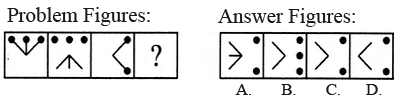
The first figure changes into the second figure in two ways:
The main shape is rotated 180°
The V shape points downward in Figure 1.
It points upward in Figure 2.
The dots move to the opposite side
The 3 dots are at the ends of the lines in Figure 1.
They move to the opposite side in Figure 2.
The number of dots stays the same.
Apply the Rule to Figure 3
Figure 3 is rotated 180°, so the shape changes from < to >.
The 2 dots move to the opposite side.
The number of dots remains
Therefore, the correct figure is:
Answer: C
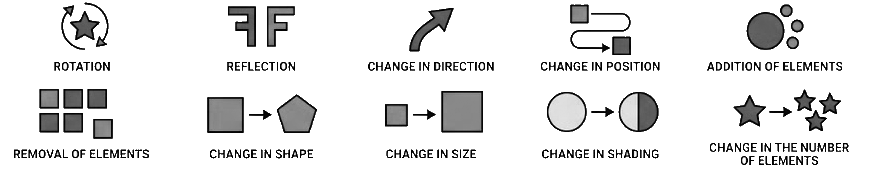
What Should You Observe?
Look carefully for:
👉 Rotation
👉 Reflection
👉 Change in direction
👉 Change in position
👉 Addition of elements
👉 Removal of elements
👉 Change in shape
👉 Change in size
👉 Change in shading
👉 Change in the number of elements
Example
If: Figure A → Figure B
shows a 90° clockwise rotation, then:
Figure C → ?
should also show a 90° clockwise rotation.
Figure Analogy Method
When examining a figure analogy, check the transformation in this order:
Direction → Position → Shape → Number → Shading → Rotation
Do not select an option simply because it looks similar. Identify the exact transformation.
How to Solve Analogy Questions
Use the following systematic method to solve analogy questions quickly and accurately.
Step 1: Examine the First Pair
Look carefully at:
A : B
Try to identify exactly what connects the two terms.
Step 2: Identify the Relationship
Ask:
How is A related to B?
For Example: Bird: Fly
Relationship: A bird can fly.
Step 3: Apply the Same Relationship
Now examine:
Fish : ?
A fish can: Swim
Therefore: Answer: Swim
Step 4: Check the Options
Compare all the options carefully.
The correct answer must follow the same relationship, not simply have a general connection with the given word.
Step 5: Check the Direction
The order of the terms is important.
For example:
Doctor : Hospital
is different from:
Hospital : Doctor
Always maintain the same direction as the original pair.
Step 6: Use Elimination
If you are unsure, eliminate options that clearly do not follow the required relationship.
This can increase your chance of selecting the correct answer.
Step 7: Manage Your Time
Do not spend too much time on one difficult question.
Use the strategy:
Solve → Mark if necessary → Move on → Return later
Effective Tricks to Solve Analogy Questions
Trick 1: Identify the Exact Relationship
Do not choose an answer simply because the two words are related.
Find the specific relationship between them.
For example:
Knife : Cut
The relationship is not simply “knife is related to cut.”
The exact relationship is:
A knife is used to cut.
Trick 2: Turn the Relationship into a Sentence
Creating a simple sentence can make the relationship easier to recognize.
Example:
Teacher : School
→ A teacher works in a school.
Now apply the same sentence pattern to the second pair.
Trick 3: Maintain the Direction
Always follow:
A → B
Then apply the same direction:
C → ?
Do not reverse the relationship.
Trick 4: Check Simple Operations First
For numerical analogy questions, check simple operations first:
+ → − → × → ÷ → Square → Cube
Only consider more complicated patterns if the simple operations do not work.
Trick 5: Convert Letters into Numbers
For difficult letter analogy questions, use alphabet positions:
A = 1, B = 2, C = 3, … Z = 26
This can make hidden relationships easier to identify.
Trick 6: Observe Figures Systematically
For non-verbal analogy questions, check:
Position → Direction → Rotation → Shape → Number → Shading
This helps prevent you from choosing an answer based only on appearance.
Trick 7: Use Elimination
When you cannot immediately identify the answer, eliminate options that clearly do not follow the required relationship.
Important Tips for Analogy Questions
Tip 1: Learn Common Relationships
Become familiar with frequently used verbal relationships such as:
Part–Whole, Worker–Tool, Worker–Workplace, Object–Function, Country–Capital, Synonym, Antonym, and Animal–Sound.
Tip 2: Practice Different Types
Do not practice only verbal analogy questions. To prepare effectively, practice different types of analogy questions, including Verbal Analogy, Numerical Analogy, Letter Analogy, and Non-Verbal Analogy. Practicing all these types helps improve your reasoning skills, pattern recognition, and ability to solve different kinds of analogy questions quickly and accurately.
Tip 3: Focus on Accuracy
A quick answer is useful only when it is correct.
Develop the habit of identifying the relationship first and then selecting the answer.
Tip 4: Practice Against the Clock
Once you understand the concept, solve analogy questions under a time limit.
This helps improve both speed and accuracy.
Tip 5: Review Your Mistakes
Do not focus only on your score. After completing a practice test, review your mistakes and ask yourself
why you chose the wrong answer.
Check whether you misunderstood the relationship, missed a simple pattern, reversed the direction, made a calculation error, or spent too much time on the question. Understanding and learning from your mistakes is one of the best ways to improve your reasoning ability and perform better in future tests.
Practice Questions
Conclusion
Mastering the Analogy Test is essential for success in the Nepal Army Officer Cadet Entrance Examination. Success requires identifying the logical relationship between two words, numbers, letters, or figures and applying the same relationship to find the correct answer. Follow a systematic approach: Observe → Compare → Identify the Relationship → Apply → Verify → Answer. Regular practice improves logical thinking, relationship recognition, speed, accuracy, and confidence.
This resource is part of the Officer Cadet Entrance Exam Preparation series, focusing on IQ and Logical Reasoning for the Nepal Army Officer Cadet Entrance Exam. For structured lessons, comprehensive practice banks, and mock tests, explore the Analogy Test subtopic under the Verbal Reasoning topic in the IQ and Logical Reasoning course on the Pratima Academy LMS.