
Odd One Out Test is an important part of IQ and Logical Reasoning that tests your ability to identify the item that does not share the common property or pattern of the other items.
For Officer Cadet Entrance Exam preparation, Odd One Out questions help develop observation, analytical thinking, pattern recognition, and quick decision-making skills. Explore the complete Officer Cadet Exam resources and IQ for Officer Cadet preparation for additional practice and study materials.
What is an Odd One Out Test?
An Odd One Out Test presents you with a set of items — words, numbers, letters, or figures — where every item except one shares a single common property. Your task is to identify the exception.
Basic Pattern
You are given a set of items like: Apple, Banana, Mango, Carrot
Your task is to identify the one item that does not belong:
Apple, Banana, and Mango are fruits. Carrot is a vegetable.
Answer: Carrot
What Does an Odd One Out Test Measure?
Odd One Out questions test your ability in:
👉 Observation and attention to detail
👉 Categorization
👉 Analytical thinking and reasoning
👉 Pattern recognition
👉 Speed and accuracy
Preparation Strategy
To improve your performance:
👉 Look for the most obvious category first.
👉 If the obvious category fits every item, look for a finer, more specific property.
👉 Check for attributes like function, composition, and origin.
👉 For numbers, check for prime, composite, square, and cube relationships.
👉 For letters, check positions in the alphabet, vowel/consonant patterns, and gaps.
👉 For figures, check shape, size, direction, shading, and number of elements.
👉 Practice a wide variety of Odd One Out formats, including mixed sets.
Types of Odd One Out Questions
1. Word Odd One Out
Finding the odd word based on meaning, category, spelling, or grammatical form.
Example:
Question: Find the odd one out: Doctor, Engineer, Teacher, Lawyer, Hospital
Analysis: Doctor, Engineer, Teacher, and Lawyer are all professions. Hospital is a place where a doctor might work, not a profession.
Answer: Hospital
Example:
Question: Find the odd one out: Apple, Banana, Mango, Carrot
Analysis: Apple, Banana, and Mango are fruits. Carrot is a vegetable.
Answer: Carrot
2. Number Odd One Out
Finding the odd number based on mathematical properties or patterns.
Example:
Question: Find the odd one out: 234, 345, 456, 474
Analysis:
👉 234: digits are consecutive (2, 3, 4)
👉 345: digits are consecutive (3, 4, 5)
👉 456: digits are consecutive (4, 5, 6)
👉 474: digits are not consecutive (4, 7, 4)
Answer: 474
Example:
Question: Find the odd one out: 4, 9, 16, 25, 36, 49, 64, 100
Analysis: 4 = 2², 9 = 3², 16 = 4², 25 = 5², 36 = 6², 49 = 7², 64 = 8², and 81 would be 9² — but 100 = 10² skips 81. All others are consecutive squares from 2² to 8²; 100 breaks the sequence.
Answer: 100
3. Letter Odd One Out
Finding the odd letter or letter group based on alphabetical position, vowel/consonant status, or structure.
Example:
Question: Find the odd one out: A, E, I, O, U, V
Analysis: A, E, I, O, U are vowels. V is a consonant.
Answer: V
Example:
Question: Find the odd one out: AC, DF, GI, KM
Analysis:
AC: gap of 1 (A = 1, C = 3)
DF: gap of 1 (D = 4, F = 6)
GI: gap of 1 (G = 7, I = 9)
KM: gap of 2 (K = 11, M = 13)
Answer: KM
4. Figure Odd One Out
Finding the odd figure based on shape, size, direction, shading, or number of elements.
A Figure Odd One Out question presents a set of figures. Your task is to find the one that does not follow the shared visual pattern.
Method
Observe the figures for patterns in:
👉 Shape
👉 Size
👉 Direction/orientation
👉 Shading
👉 Number of elements or sides
👉 Rotation
Example:
Question: Find the odd one out: Square, Hexagon, Octagon, Rectangle, Pentagon
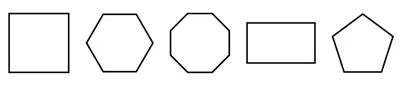
Analysis:
👉 Square — 4 sides (even)
👉 Hexagon — 6 sides (even)
👉 Octagon — 8 sides (even)
👉 Rectangle — 4 sides (even)
👉 Pentagon — 5 sides (odd)
Four figures have an even number of sides; the pentagon has an odd number of sides.
Answer: Pentagon
5. Mixed Odd One Out
A combination of words, numbers, and letters within the same set.
These questions combine words, numbers, and letters within a single set, usually linked by what each item represents rather than what category it belongs to.
Example
Question: Find the odd one out: 5, Seven, III, V
Analysis: 5, Seven, and V all represent the number five (as a numeral, a word, and a Roman numeral). III represents the number three.
Answer: III
How to Solve Odd One Out Questions
Use the following systematic method to solve Odd One Out questions quickly and accurately.
Step 1: Read the Question Carefully
👉 Note the type of items given — words, numbers, letters, figures, or a mix — since this determines which properties to check first.
Step 2: Look for the Obvious Category
👉 Start with the most obvious shared property. Are they all fruits, animals, or shapes?
Step 3: Look for a Finer Property
👉 If every item fits the broad category, look for a more specific property shared by all but one.
Step 4: Check for Alternative Patterns
👉 If you can’t find a pattern in meaning, check spelling, letter count, alphabetical position, or mathematical relationships.
Step 5: Confirm There Is Only One Exception
👉 Test your candidate answer against the rest of the set. If two items seem to break the rule, your rule is not specific enough — return to Step 3.
Step 6: Verify Your Answer
👉 Once you’ve identified the odd one out, confirm that it genuinely fails to share the property that every other item has.
Effective Tricks to Solve Odd One Out Questions
Trick 1: Look for the Most Specific Rule
👉 Many items will share a broad category. The correct answer is often found only by identifying a more specific rule that applies to all but one.
Trick 2: For Words, Check Meaning and Form
👉 If you can’t find a pattern in meaning, check for patterns in spelling, number of letters, or grammatical category.
Trick 3: For Numbers, Check Basic Properties First
👉 Before looking for complex mathematical relationships, check odd/even, prime/composite, and square/cube status first.
Trick 4: For Letters, Use Alphabet Positions
👉 Converting letters to numbers is the most reliable way to identify patterns in letter Odd One Out questions.
Trick 5: For Figures, Check Visual Properties Systematically
👉 Go through shape, size, direction, shading, and number of elements one at a time rather than trying to spot everything at once.
Trick 6: Use the Process of Elimination
👉 Even if you are unsure, eliminate items that clearly fit a common category to narrow down the choices.
Trick 7: Be Open to Multiple Candidate Patterns
👉 Sometimes more than one pattern seems to fit. Choose the one that is most logical and explains all but exactly one item — if a pattern leaves two items unexplained, it is the wrong pattern.
Important Tips to Solve Odd One Out Questions
👉 Look for the most obvious category first, then move to a finer, more specific property if every item fits.
👉 For words, check meaning first, then spelling, letter count, or grammatical form.
👉 For numbers, check odd/even, prime/composite, and square/cube properties before complex relationships.
👉 For letters, convert them to alphabet positions to spot patterns reliably.
👉 For figures, check shape, size, direction, shading, and number of elements one at a time.
👉 Use the process of elimination to narrow down the choices when unsure.
👉 Choose the pattern that explains all but exactly one item — if two items are left unexplained, the pattern is wrong.
👉 Always verify your answer by confirming that it genuinely fails to share the common property.
Practice Questions
Conclusion
Mastering the Odd One Out Test is essential for the Nepal Army Officer Cadet Entrance Examination, where it is tested separately from the Classification Test across the Verbal, Numerical, and Non-Verbal Reasoning sections of the syllabus. While both topics rely on spotting a shared property, Odd One Out specifically rewards the ability to identify a single exception in a set — not to sort items into multiple groups. Follow a disciplined approach: Observe → Identify the Rule → Find the Exception → Verify. Regular practice across word, number, letter, figure, and mixed formats strengthens observation, analytical thinking, speed, and accuracy.
This resource is part of the Officer Cadet Entrance Exam Preparation series, focusing on IQ and Logical Reasoning for the Nepal Army Officer Cadet Entrance Exam. For structured lessons, comprehensive practice banks, and mock tests, explore the Odd One Out Test course on the Pratima Academy LMS.